

Dhurandhar Movie Playbook : Case Study in Momentum Engineering
Seven Structured Marketing Lessons from Bollywood’s Most Counter-Intuitive Commercial Success
EXECUTIVE SUMMARY
Dhurandhar (2025) and its sequel Dhurandhar: The Revenge (2026) are not merely box-office phenomena—they constitute a masterclass in counter-cyclical brand marketing that every product launcher, CMO, and founder should study. While Bollywood’s default playbook demands saturation-level promotion—TV appearances, city tours, influencer seeding—director Aditya Dhar and Jio Studios deployed a radically different strategy that achieved a cumulative worldwide gross of ₹2,950+ crore across both films.
This report extracts seven structured marketing lessons from the Dhurandhar franchise, translating each into a replicable framework with clear definitions, mechanisms, and application guidelines. These are not retrospective narratives—they are operating principles that can be stress-tested across product launches, brand campaigns, and go-to-market strategies in any industry.
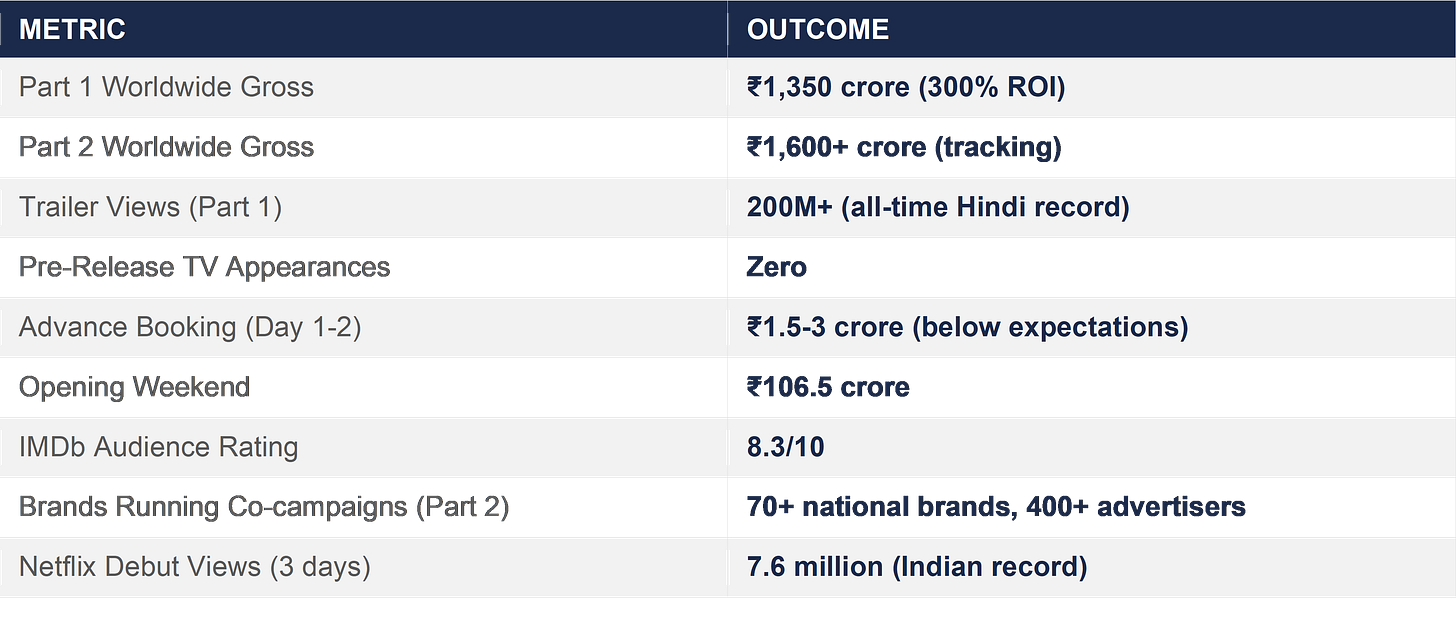
THE CORE PARADOX
Dhurandhar spent less on promotion than any comparable ₹1,000-crore film—yet generated more organic media impressions, more brand co-marketing partnerships, and more sustained cultural conversation than any Bollywood release in history. The question this report answers: How?
LESSON 1: THE CURIOSITY GAP PRINCIPLE
Framework: Strategic Information Asymmetry
**Definition:**The Curiosity Gap is a behavioural economics concept (Loewenstein, 1994) where the deliberate withholding of specific information creates a cognitive itch that the audience actively seeks to resolve. In marketing, this translates to designing information release schedules that provide just enough to activate interest without satisfying it.
How Dhurandhar Applied It
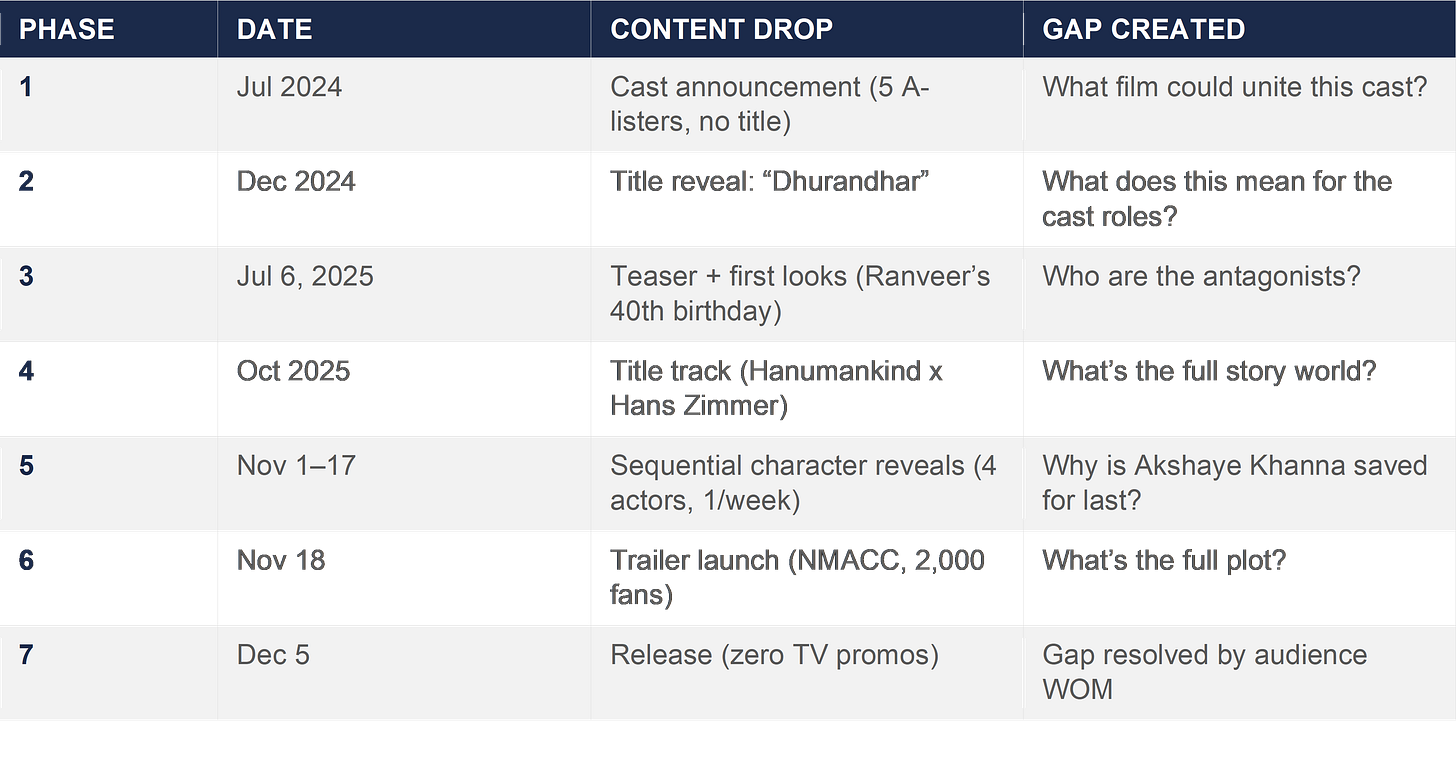
The 17-month campaign (July 2024 – December 2025) was structured as a seven-phase drip-feed where each content drop answered one question while raising two new ones:
The Mechanism: Why It Works
Each phase was engineered to sustain what behavioural scientists call “information deprivation”—a state where the audience knows enough to care but not enough to stop seeking. The critical design choice was that no two phases revealed the same category of information. Phase 1 answered “who” but not “what.” Phase 2 answered “what” but not “how.” Phase 3 answered “tone” but not “story.” This category-rotation prevented audience fatigue while maintaining forward momentum.
CLIENT APPLICATION
When launching a product, brand, or service, map your pre-launch communications to a Curiosity Gap Calendar. Identify 5-7 information categories (e.g., team, product, pricing, design, partnerships, testimonials, availability). Release one category per phase, ensuring each reveal opens a new question. The rule: every content drop should generate at least 2x the search queries it resolves.
LESSON 2: THE SCARCITY-SIGNALS-QUALITY HEURISTIC
Framework: Promotional Restraint as a Trust Signal
**Definition:**In consumer psychology, the volume of promotion a brand engages in is itself a signal. Excessive promotion signals desperation (“If the product were good, they wouldn’t need to push this hard”). Conversely, deliberate promotional restraint signals confidence—a heuristic the Dhurandhar team exploited with surgical precision.
What Dhurandhar Did Differently
The campaign made three radical omissions that broke every Bollywood convention:
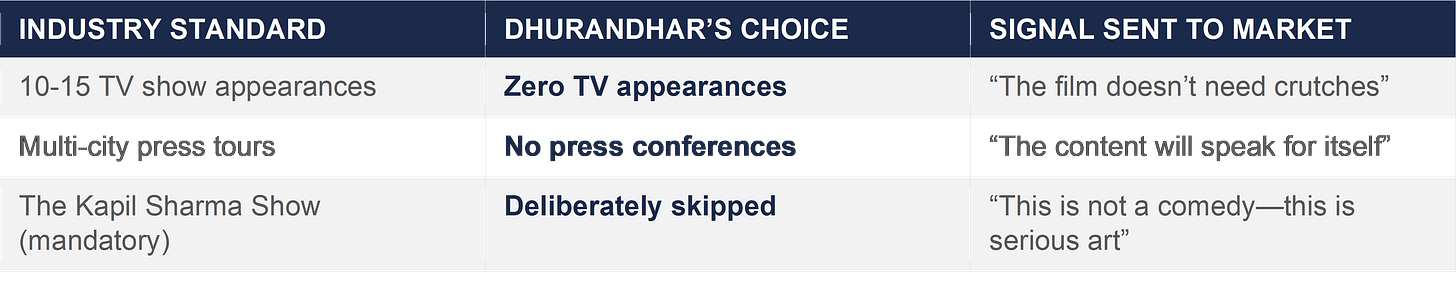
Marketing strategist Varun Gupta—the architect behind four ₹1,000-crore campaigns including RRR and Animal—articulated the governing logic: “Marketing only controls the opening weekend—Days 1 through 3. After that, the audience’s word-of-mouth takes over.” The team calculated that for a film of demonstrable quality, restraint would generate more curiosity than saturation.
Ranveer Singh personally championed this approach, having internalised the overexposure lesson from Cirkus (2022), where exhaustive promotion was widely seen as counterproductive. The learning: your most recent failure’s post-mortem should inform your next campaign’s architecture.
CLIENT APPLICATION
Before your next launch, run a Promotional Audit. List every planned touchpoint. For each, ask: “Does this add curiosity, or does it relieve pressure the audience hasn’t built yet?” Cut 30-50% of your planned activities. Redirect that budget to product quality, post-launch community management, or earned-media seeding. The principle: underspend on telling people how good you are; overspend on making the experience so good they tell each other.
LESSON 3: SEQUENTIAL CHARACTER REVEALS AS LAUNCH SEQUENCING
Framework: The Stakeholder Spotlight Model
**Definition:**In multi-stakeholder product launches, the order and timing in which you introduce key players (founders, advisors, partners, features) determines the narrative arc. The Stakeholder Spotlight Model assigns each key player or feature its own dedicated news cycle, preventing cannibalization and maximising total share-of-voice.
How the Akshaye Khanna Reveal Was Engineered
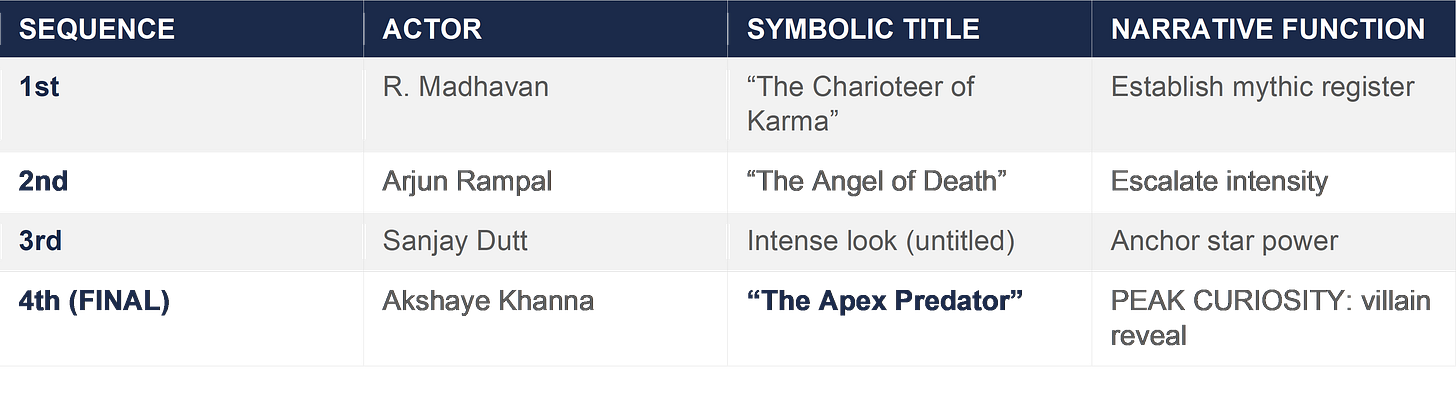
In November 2025, the team released one character poster per week over 17 days. Each was given a symbolic title designed to anchor social media conversation:
The Mechanism: Recency Bias + Peak-End Rule
By saving Akshaye Khanna—the primary antagonist—for last, the team exploited two cognitive biases simultaneously. Recency bias ensured his reveal was the freshest memory when the trailer dropped the very next day. The Peak-End Rule (Kahneman, 1999) meant the sequence’s emotional peak and its endpoint were the same event, maximising the overall perceived intensity of the pre-release period.
When the trailer dropped on November 18, Akshaye Khanna’s portrayal of Rehman Dakait dominated conversation. The trailer crossed 46 million views in Week 1—more than double Uri’s record—and eventually surpassed 200 million total views. Every subsequent piece of coverage anchored on his character.
CLIENT APPLICATION
When launching a multi-feature product or a team-led consultancy, do NOT reveal everything at once. Build a Spotlight Calendar: Feature A in Week 1, Feature B in Week 2, and your most differentiated capability last. The anchor principle: whatever you reveal last becomes the frame through which everything before it gets reinterpreted.
LESSON 4: THE UNPLANNED VIRAL LOOP
Framework: Seeding Memetic Infrastructure Without Scripting Memes
**Definition:**A Memetic Infrastructure is the set of conditions—distinctive visuals, quotable dialogue, unexpected casting—that make a piece of content meme-ready without prescripting specific memes. The viral loop is the audience’s self-replicating distribution system, which cannot be manufactured but CAN be enabled.
The Rakesh Bedi Phenomenon: Anatomy of Organic Virality
Rakesh Bedi’s character Jameel Jamali was entirely absent from all pre-release marketing—no poster, no teaser, no individual reveal. The character was discovered by audiences inside the theatre. Casting director Mukesh Chhabra revealed that 2-3 actors had rejected the role before Bedi was brought on board.
Post-release, Bedi’s dialogue “Bachcha hai tu mera” (You’re my child) triggered what marketing scientists call a cascading adoption curve:
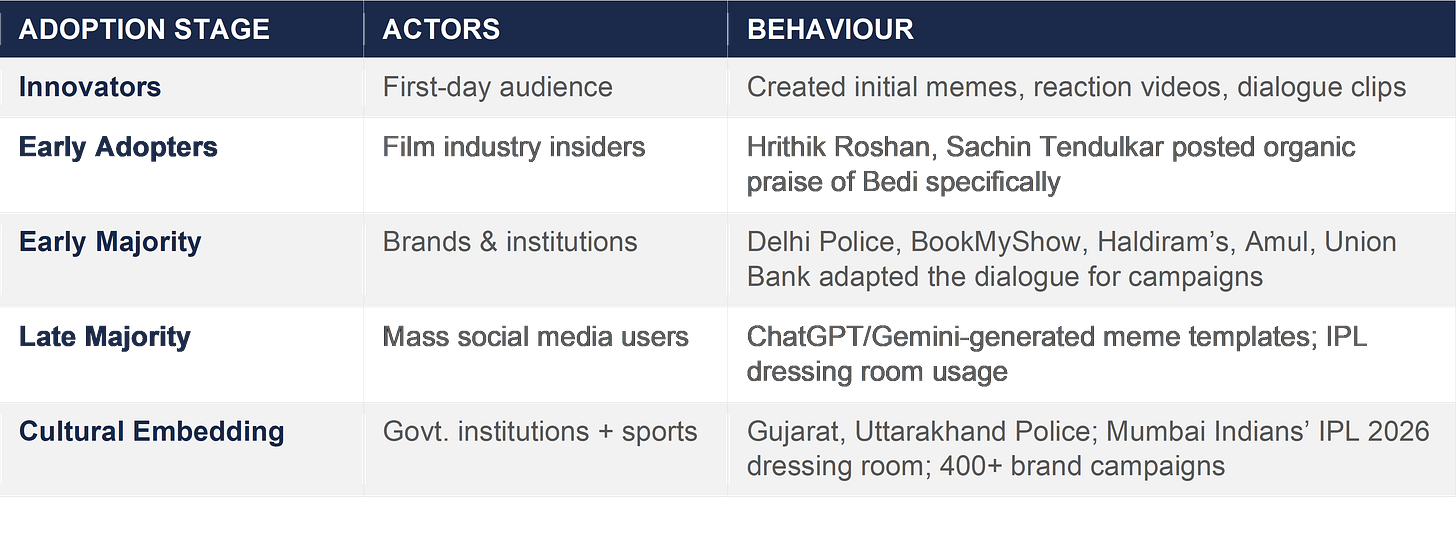
What Made It Meme-Ready (The Infrastructure)
The team did not plan Bedi’s virality. But they created three structural conditions that enabled it:
- Counter-casting: A comedian (known for Shola Aur Shabnam, Masti) in a menacing political villain role creates cognitive dissonance—the gap between expectation and reality is inherently shareable. 2. Dialogue Design: “Bachcha hai tu mera” is short (5 words), universally applicable (can be grafted onto any authority-subordinate context), and emotionally loaded—the three prerequisites of a viral catchphrase. 3. Surprise Factor: Because Bedi was absent from all pre-release material, his appearance was a genuine in-theatre surprise—audiences felt they had “discovered” something, which is the most powerful driver of sharing behaviour.
CLIENT APPLICATION
You cannot manufacture virality, but you can manufacture the conditions for it. In every product/campaign, embed at least one “surprise asset”—an undisclosed feature, an unexpected spokesperson, a hidden Easter egg. Design your most quotable element to be: (a) under 7 words, (b) context-flexible, and (c) emotionally resonant. Then keep it out of the pre-launch entirely. Let the audience discover it and feel ownership of the find.
LESSON 5: THE INVERTED BOX OFFICE CURVE
Framework: Product-Led Growth Applied to Entertainment
**Definition:**In SaaS and consumer tech, Product-Led Growth (PLG) describes a strategy where the product itself—not marketing—is the primary driver of customer acquisition, retention, and expansion. Dhurandhar’s box office trajectory is the entertainment equivalent of a PLG curve: soft initial adoption followed by explosive organic growth.
The Data: An Unprecedented Upward Trajectory
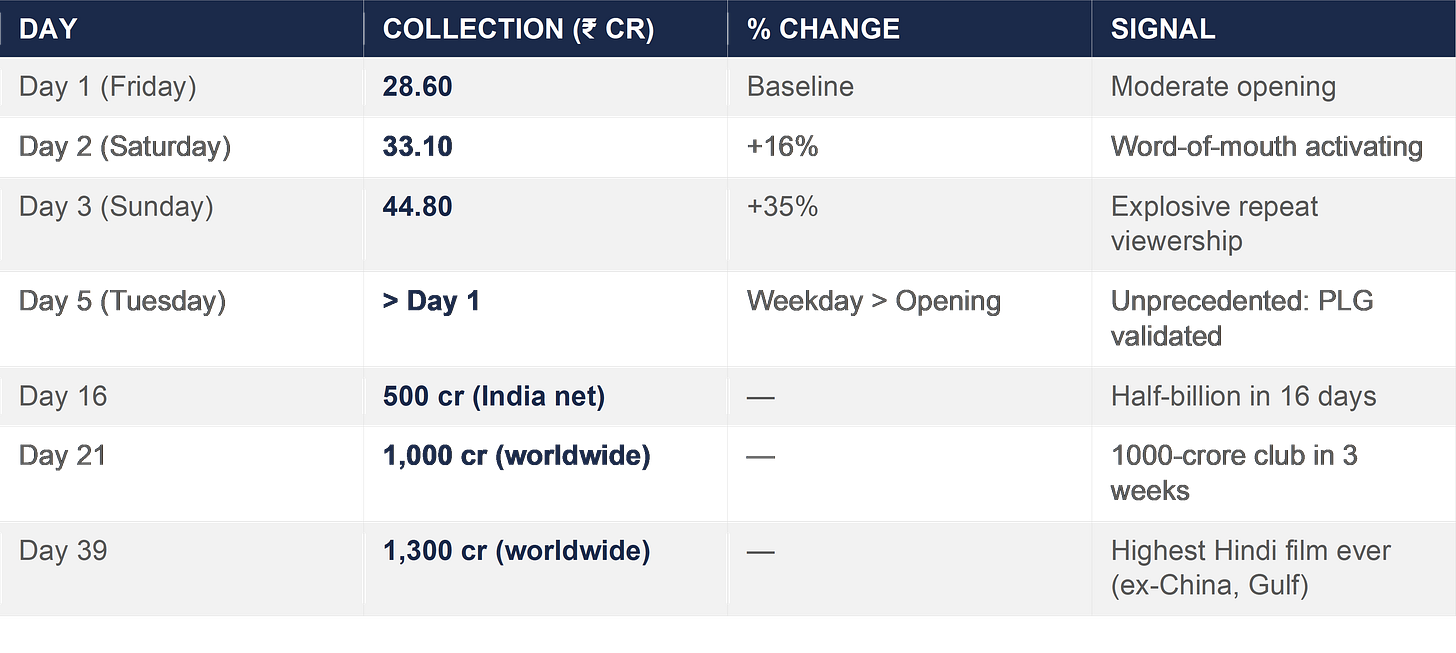
The Mechanism: Why Days 5-6 Exceeded Day 1
In standard Bollywood economics, a film’s Tuesday collection is typically 40-60% below its Friday figure. Dhurandhar inverted this pattern entirely. The mechanism was threefold:
- Social Proof Cascade: Weekend viewers became unpaid marketers. Their WhatsApp statuses, Instagram stories, and X posts carried more credibility than any paid campaign could. 2. FOMO Amplification: The low pre-release promotion meant many potential viewers had not committed to opening weekend. When the WOM tsunami hit, the “I haven’t seen it yet” cohort rushed to theatres mid-week. 3. Repeat Viewership Economics: The film’s layered narrative and ensemble cast incentivized second and third viewings—each audience member had a different character to follow, a different scene to re-evaluate.
CLIENT APPLICATION
Design your launch for a soft open, not a hard launch. Reserve marketing budget for Days 5-14, not Days 1-3. Build product features that reward re-engagement (second visit, second purchase, shared experience). The metric that matters is not opening-day volume—it’s the slope of the curve from Day 3 to Day 10. If it’s positive, you have a PLG engine.
LESSON 6: THE ORGANIC ENDORSEMENT CASCADE
Framework: Post-Release Celebrity Seeding vs. Pre-Release Influencer Marketing
**Definition:**Traditional influencer marketing pays for pre-release endorsements. The Organic Endorsement Cascade flips this model: create a product so compelling that high-credibility voices endorse it voluntarily after experiencing it, generating earned media at zero marginal cost.
The Cascade in Action
The Dhurandhar team did not pay celebrities to post. Instead, they allowed the film’s quality to trigger a self-reinforcing endorsement chain:
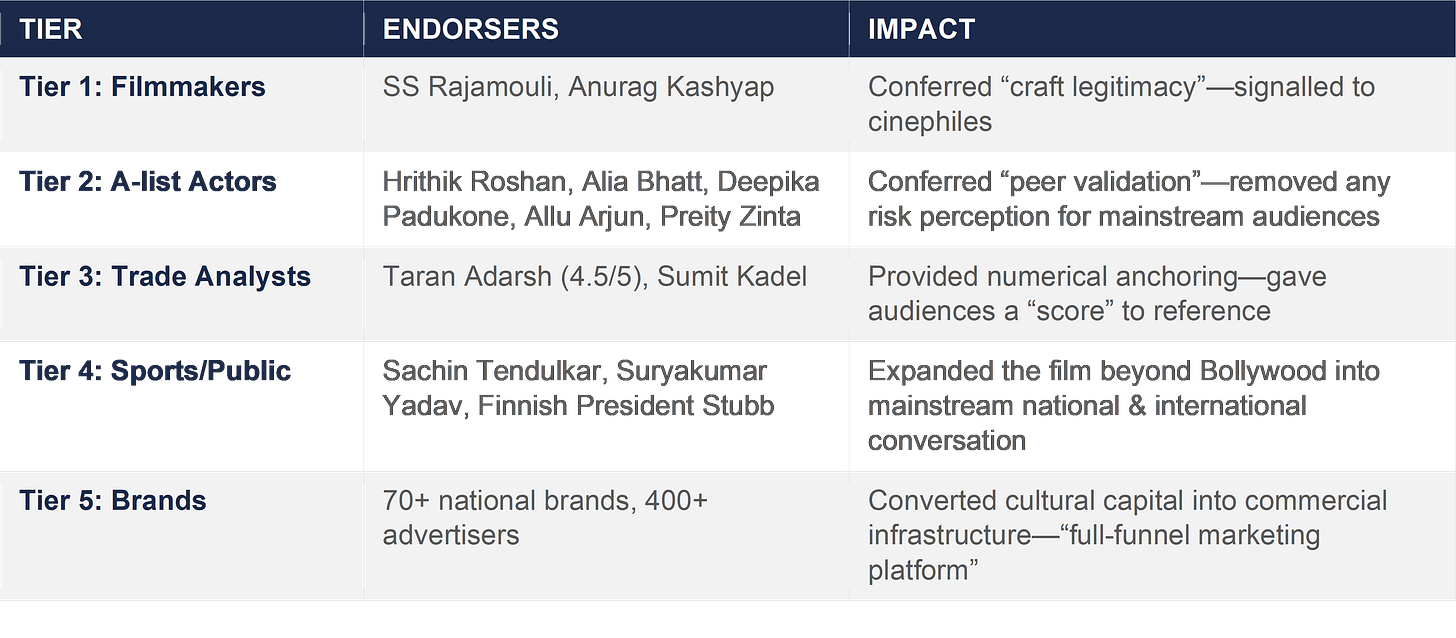
The interval-based posting pattern that emerged on X and Instagram was organic but structurally predictable. Each new celebrity post reignited the conversation cycle, creating what network theorists call a self-exciting point process—each event increases the probability of the next event. Hrithik’s post prompted Vivek Agnihotri’s. Taran Adarsh’s review prompted Sumit Kadel’s counter-analysis. The team didn’t need to orchestrate a posting schedule because the quality of the product created its own cadence.
CLIENT APPLICATION
Stop buying pre-launch influencer endorsements for products that haven’t shipped. Instead, invest in a curated “First 50” programme: identify 50 high-credibility voices in your industry, give them early access to the finished product with zero strings attached, and let them post if and when they choose. The credibility differential between a paid post and an organic endorsement is approximately 7:1 in trust metrics (Edelman Trust Barometer). Your product IS your marketing strategy.
LESSON 7: CULTURAL INFRASTRUCTURE AS A BRAND MOAT
Framework: From Product Launch to Cultural Platform
**Definition:**A Cultural Platform emerges when a brand’s assets (dialogue, visuals, characters, symbols) become so embedded in public discourse that third parties—brands, institutions, governments—voluntarily adopt them for their own communications. This transforms a one-time product launch into a self-sustaining cultural infrastructure with near-zero incremental marketing cost.
Dhurandhar’s Transformation into a Cultural Platform
Exchange4media described Dhurandhar 2 as having evolved into a “full-funnel marketing hub for brands.” The film’s cultural assets were repurposed across sectors:
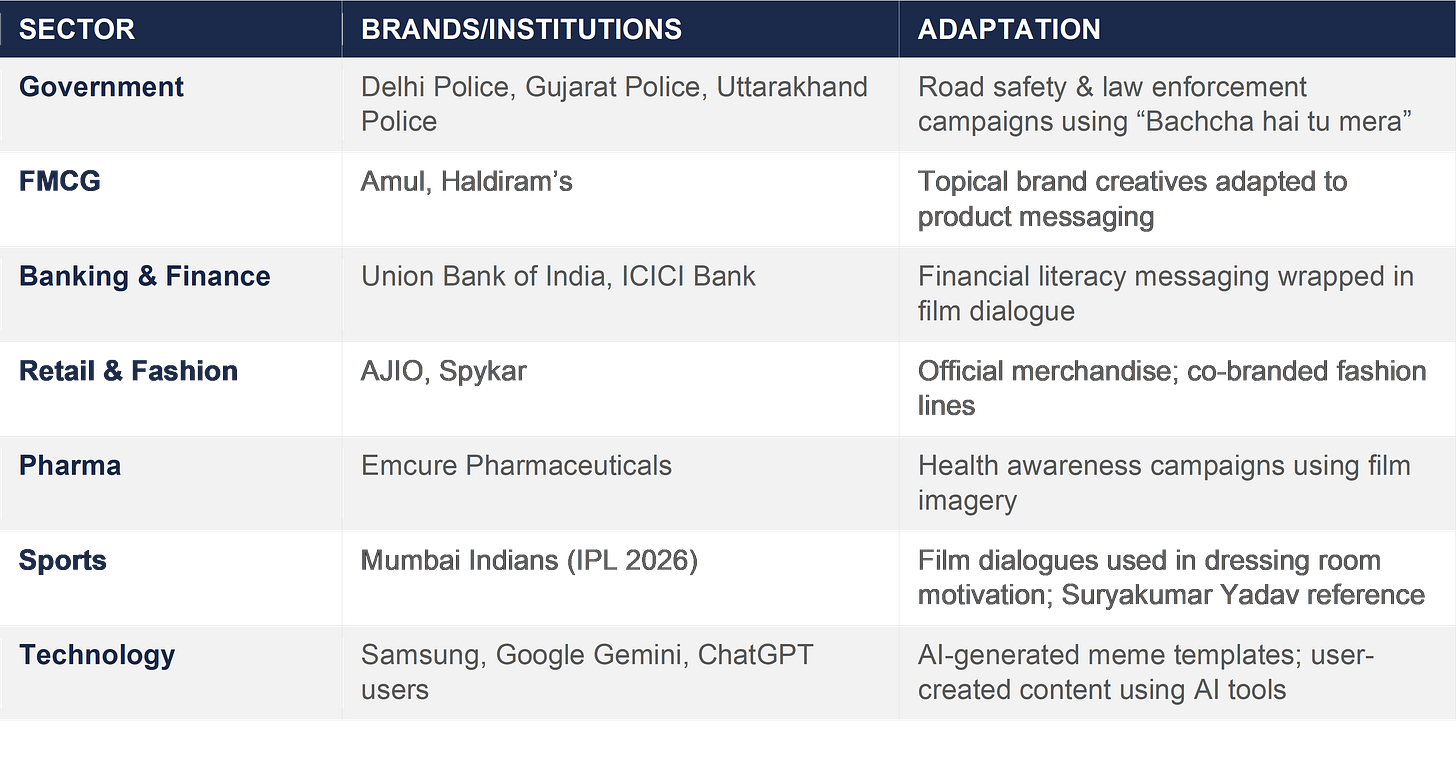
The total earned media value from these 400+ brand campaigns is conservatively estimated at multiples of the film’s entire marketing spend. More importantly, it created a feedback loop: brand campaigns drove more conversations about the film, which drove more box office collections, which attracted more brand campaigns. This is the flywheel effect that transforms a product launch into a cultural institution.
CLIENT APPLICATION
Design brand assets for adaptability, not just recognition. Ask: can a third-party brand seamlessly insert your tagline, visual, or character into their own context? If yes, you have Cultural Platform potential. Create a Brand Adaptation Kit—approved templates, dialogue variations, visual assets—and make it freely available to potential co-marketers. The brands that adopted Dhurandhar’s assets didn’t ask permission—they saw the cultural momentum and acted. Make it easy for them.
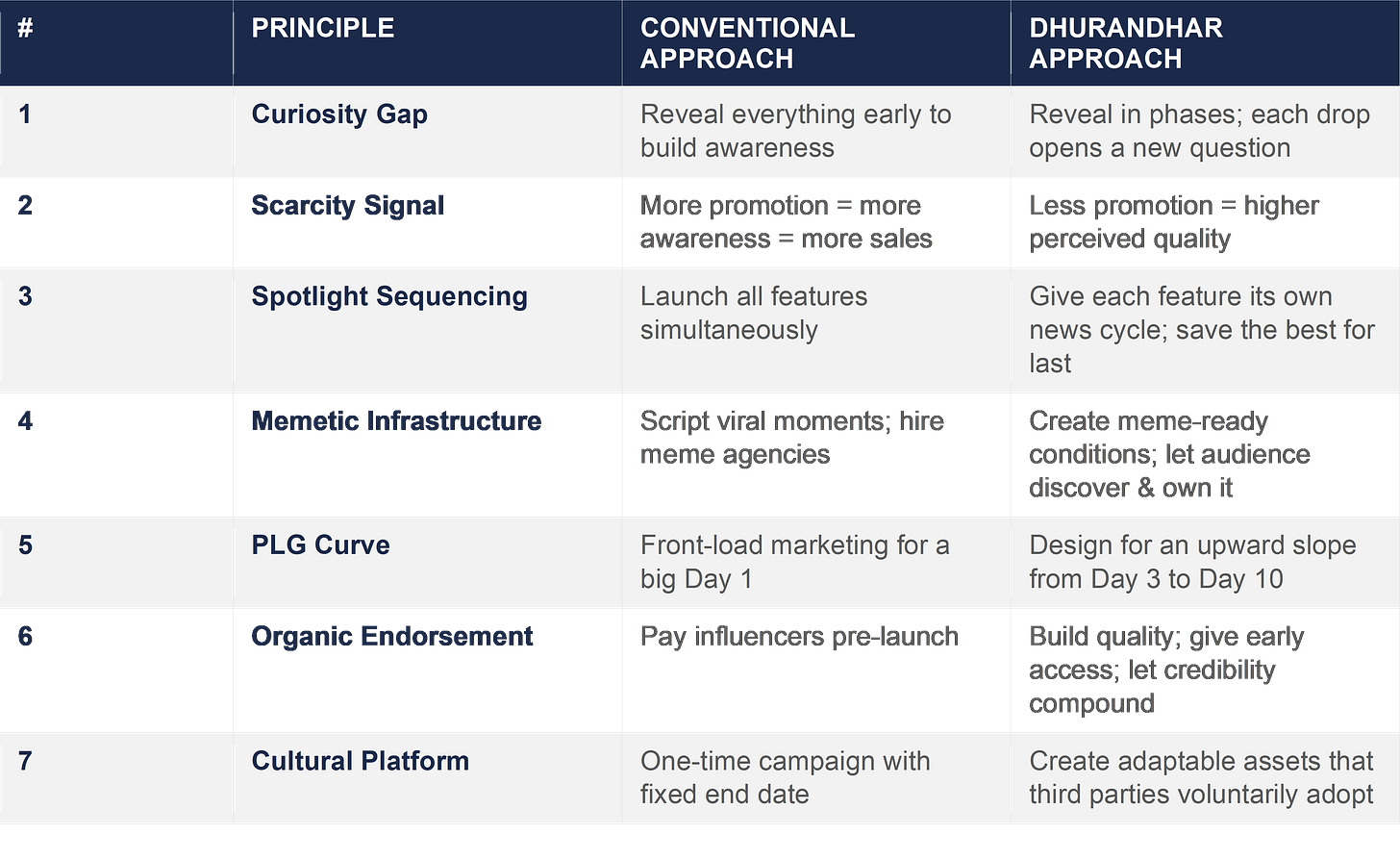
SYNTHESIS: THE DHURANDHAR DECISION MATRIX
The seven lessons can be synthesized into a single decision framework for any brand builder or CMO evaluating their launch strategy:
ABOUT BLUE MANGO CONSULTING GROUP
Blue Mango Consulting Group (bluemangoconsultinggroup.com) is a full-service management consultancy serving companies of all sizes—from startups and SMEs to large corporates and established firms. Positioned as the Architect of Structural Advantage in Volatile Markets, BMCG delivers research-driven strategy across market intelligence, go-to-market design, brand positioning, and operational transformation.
© 2026 Blue Mango Consulting Group. All rights reserved.