
JFM Quarter 2026 Insights
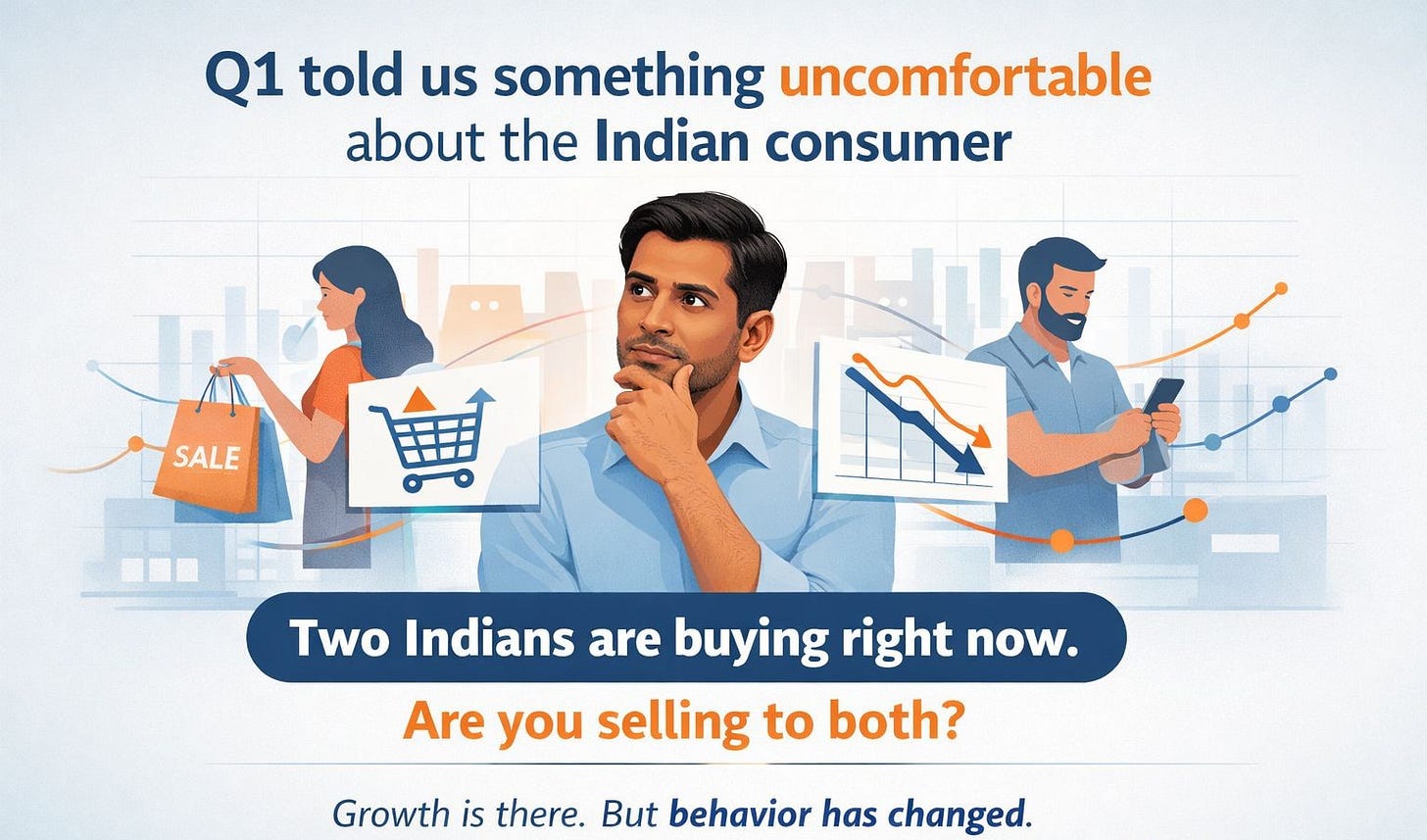
Two Indians are buying right are selling to both ?
🌍 BMCG QUARTERLY MARKET INTELLIGENCE BRIEF
Period: January – March 2026 | By Blue Mango Consulting Group
Q1 in 60 seconds: India’s retail sector clocked steady 9% growth in February 2026 after a festive high in late 2025, with Tier 3–5 towns overtaking metros in spending growth for the first time — signalling a structural geography shift in consumption. Globally, the IMF raised its 2026 growth forecast to 3.3%, aided by technology investment and resilient Asian demand, while inflation moderated across APAC to ~3.73%. The biggest geopolitical pivot of Q1 was the India-US interim trade deal struck in February — slashing tariffs from 50% to 18% and unlocking a $500 billion bilateral trade framework that reshuffles supply-chain calculus for the rest of the year.
GLOBAL MACRO SNAPSHOT
Signal 1: IMF upgrades global growth forecast; APAC leads the resilient tier
- What happened: The IMF’s January 2026 World Economic Outlook revised global growth upward to 3.3% for 2026 (from 3.2% in October 2025), driven by technology investment, fiscal support, and resilient emerging market spending. APAC inflation is forecast to ease from 4.03% to 3.73%, among the most benign in the world.
- Why it matters to Indian/Asian businesses: A growing world economy with falling APAC inflation means consumer wallets are under less pressure, credit conditions are becoming more accommodative, and the mood for spending and investment is improving across the region.
- First-order impact (0–90 days): Easier borrowing costs and stable prices support retailers, FMCG brands, and lenders in India and SE Asia. Businesses can plan inventory and pricing with more confidence heading into Q2.
- Second-order consequence (3–18 months): If technology investment (especially AI) delivers productivity gains as forecast, operating costs for SMEs using digital tools could drop further, and consumer time-saving spending (quick commerce, food delivery, digital services) will likely accelerate.
- We Recommend: Lock in credit lines now while rates are stable or softening. Use the margin breathing room from lower inflation to fund one digital capability — better listings, a CRM, or a quick-commerce integration — rather than holding cash idle.
Signal 2: India–US Interim Trade Deal — tariffs cut from 50% to 18%
- What happened: On February 6, 2026, India and the US announced an interim trade framework that slashed effective tariffs on Indian goods from a peak of 50% to 18% and established a $500 billion bilateral purchasing intent — the largest bilateral trade pivot in recent memory.
- Why it matters to Indian/Asian businesses: Indian exporters in manufacturing, pharma, tech services, and agriculture face significantly lower entry costs into the US market. However, China has already warned of consequences given India’s growing role as a supply-chain alternative.
- First-order impact (0–90 days): Export-linked sectors (garments, pharma APIs, engineering goods, IT services) see improved order flow and price competitiveness in the US. Importers of US goods (agriculture, electronics, energy) may see increased competition and price pressure domestically.
- Second-order consequence (3–18 months): India’s rare earth and pharmaceutical API import dependency on China becomes a strategic vulnerability if Beijing retaliates. Businesses sitting at this intersection — Indian pharma, electronics assembly, battery supply chains — need to accelerate alternative sourcing. On the upside, global manufacturers looking to de-risk from China will accelerate FDI into India, boosting industrial real estate, logistics, and industrial services.
- We Recommend: If you are in pharma, textiles, or engineering goods, immediately audit your China-sourced inputs and identify 1–2 domestic or alternative-origin suppliers to hedge against retaliatory disruption. If you sell services to US clients, update your pitch to include the trade-deal tailwind as a reliability signal.
🛒 CONSUMER BEHAVIOUR PULSE
3 key Q1 2026 data findings
- India’s retail sector grew 9% year-on-year in February 2026, according to the Retailers Association of India — with apparel and clothing up 12% and food/grocery up 11%, while consumer durables lagged at just 7%. Western and eastern India led regionally at 10% growth each.
- India’s consumer sentiment rose by 0.9 percentage points in March 2026, lifted by improving views on the economy and jobs — but personal finances and willingness to spend remain under pressure, creating a gap between hope and actual outlay.
- A February 2026 report found that entry-level consumers are cutting back on discretionary spending, while mid-to-upper segments continue upgrading; this is a split-screen market — mass consumption lagging, premiumisation accelerating simultaneously.
What’s actually shifting in consumer mindset this quarter
- Consumers are selectively optimistic: they believe the economy and jobs are improving, but their own pockets don’t feel it yet. This is the classic “hope without spend” moment that typically resolves in 6–9 months into genuine consumption once income confidence catches up.
- There is a growing bifurcation of India’s consumer market into two very different groups: the value-hungry majority who are stretching every rupee, and a growing aspirational middle class that is premiumising. Both groups exist simultaneously in the same city, sometimes in the same household.
- Non-metro and smaller-town consumers are driving the next leg of growth — not as afterthoughts but as primary markets, with Tier 3–5 towns overtaking metros in retail spending growth for the first time in Q1 2026.
Implications for pricing, product mix, and marketing
- Pricing strategy: Build a clear “good–better–best” pricing ladder for the same category. Do not collapse to a single price point. The mass consumer needs value assurance; the aspirational consumer needs a reason to pay more. Serve both without confusion.
- Product mix: Review your SKUs and ask which serve the entry-level shopper (smaller pack, lower ticket, outcome-focused) and which serve the premiumiser (craftsmanship, experience, story). If you only have one tier, you are already leaving money on the table.
- Marketing message: Avoid generic aspirational messaging that alienates value-seekers, and avoid exclusively value messaging that repels premiumisers. The winning frame in Q1 2026 is “smart upgrade” — quality that is worth it, accessible with EMI or right-sizing.
INDIA & ASIAN MARKET SPOTLIGHT
Story 1: Tier 3–5 Towns Overtake Metros in Retail Spending Growth
- What’s happening: India’s smallest towns (Tier 3–5) have overtaken metro and Tier 1 cities in the pace of retail spending growth in Q1 FY2026. 88% of new online shoppers added between 2020–2030 are projected to come from Tier II and smaller cities.
- On-the-ground meaning: Aspirational consumption is no longer a metro story. Shoppers in Raipur, Rajkot, Surat hinterland, and Patna are buying branded products and using e-commerce at rates that are growing faster than Mumbai or Delhi. Physical retail infrastructure and mall development in these towns are accelerating to match.
- Who wins: D2C brands willing to localise marketing in regional languages and distribute beyond Tier 1.
- Retailers and franchisors with a standardised, replicable small-format store model.
- Quick-commerce and logistics players building pin-code coverage in non-metro markets.
Story 2: RBI Holds Rate at 5.25% — A Quiet Signal of Stable Confidence
- What’s happening: In February 2026, the RBI’s MPC held the repo rate unchanged at 5.25%, maintaining its neutral stance. Inflation is projected at just 2.1% for FY2025-26 — comfortably below the 4% target. The RBI also announced consumer protection measures including ₹25,000 compensation for small digital frauds.
- On-the-ground meaning: Borrowing costs are not going up. Real interest rates are turning more favourable. For businesses, this means the cost of working capital and expansion credit stays manageable. For consumers, EMI affordability is improving, supporting big-ticket purchases.
- Who wins: NBFC and retail finance players offering EMI on durables, education, and lifestyle.
- Retailers in jewellery, furniture, and home improvement where credit-linked purchases dominate.
- MSMEs who can refinance short-term debt at more favourable terms.
Story 3: The Split-Screen Market — Mass Frugality Meets Premiumisation
- What’s happening: Across Q1 2026, entry-level consumers in India have been visibly pulling back on discretionary spend, while mid-and-upper-income shoppers continue premiumising. Apparel grew 12% nationally, but that growth is concentrated in the organised, branded, and higher-price-point segment.
- On-the-ground meaning: Retailers selling mid-range unbranded or generic products are caught in no-man’s-land — too expensive for the value-seeker, not premium enough for the aspirational buyer. The squeeze is sharpest for businesses that haven’t picked a lane.
- Who wins: Organised, branded players with clear identity and consistent quality (apparel, FMCG, food).
- Value retailers (kirana-with-tech, discount formats) that serve the bottom of the pyramid with reliability.
- Premium local brands in jewellery, food, and lifestyle that offer craftsmanship stories at aspirational price points.
💡 EMERGING BUSINESS MODEL
Model name: The Dual-Track Retail Stack
One-line description: A single retail business that runs two simultaneously operated sub-brands or product lines — one targeting value-first shoppers, one targeting premiumisers — using the same physical or digital infrastructure.
Who’s doing it: Emerging among Indian apparel retailers, FMCG companies, and food & beverage brands who recognised the bifurcation in Q1 2026 consumer data and are operationally separating their value and premium propositions instead of blending them into one muddled mid-market offer.
How it works (4 steps)
- Segment ruthlessly: Use sales data, basket size, and location data to identify which % of your current customers are value-driven vs. aspirational. Even a 60/40 split justifies a dual strategy.
- Build two distinct propositions: Create a “core” line (functional, smaller pack/ticket, clear ROI messaging) and a “signature” line (crafted, story-led, higher margin). Different names, different packaging — but produced from the same supply chain.
- Sell through separate channels or shelf zones: Value line goes to marketplace / kirana / quick-commerce. Signature line goes to own website, premium retail outlets, or branded shop-in-shop.
- Market each with a different voice: Value line = facts, savings proof, reviews. Signature line = emotion, identity, craftsmanship, creator content. Never mix the two in the same ad or post.
Revenue streams
- Higher volume / lower margin on value line drives scale and customer acquisition.
- Higher margin / lower volume on signature line drives profitability and brand equity.
- Cross-sell opportunities (value customers eventually “graduate” to signature line).
- Licensing and franchise revenues if the dual-track model scales beyond owned stores.
Why now: The Q1 2026 bifurcation in India — mass frugality at one end, premiumisation at the other — means a single-price-point strategy will leave a growing portion of your potential market unserved. The infrastructure for dual-tracking (D2C + marketplace + quick commerce) is now available even to SMEs.
Who should steal this idea
- Mid-market clothing, footwear, and lifestyle retailers stuck between fast fashion and premium.
- F&B and FMCG brands with broad distribution seeking to grow margins without shrinking reach.
- Jewellery retailers in Tier II/III who serve both daily-wear and occasion-wear buyers.
CHALLENGE → OPPORTUNITY CASE STUDY
Pattern: India’s Tier 3–5 Retail Boom — From Infrastructure Gap to Structural Advantage
The challenge India’s non-metro markets have historically been underserved by organised retail: poor supply chain connectivity, low credit access, limited brand presence, and the assumption that aspirational demand was a Tier 1-only story. Most brands built for Mumbai and Delhi first, treating smaller cities as an afterthought.
What they did Brands and e-commerce players that moved early into Tier 2/3 markets — through franchise kiosks, regional-language digital storefronts, WhatsApp-led sales, and partnered last-mile logistics — found demand that was not only large but also stickier (lower competition, higher brand recall). Retail mall developers accelerated into 30+ non-metro cities in 2025–2026 on the back of rising income levels and infrastructure upgrades.
Result/trajectory Tier 3–5 towns overtook metros in retail spending growth pace in Q1 2026. 88% of new online shoppers being added to India’s e-commerce ecosystem are from Tier II and smaller markets, and India’s retail market is projected to more than double to ₹210–215 trillion by 2035, with a significant portion of that coming from non-metro demand.
Second-order effect most people miss As non-metro consumers become more brand-aware and digitally savvy, the cost of acquiring a non-metro customer is rising fast — it is not cheap forever. The brands that entered in 2023–2025 will have built loyalty moats before the market became crowded. By 2027–2028, non-metro will be as expensive to enter as Tier 1 is today. The window for low-cost brand-building in these markets is open now, but it is closing.
Takeaway principle for Business’s First-mover advantage in an underserved geography is a depreciating asset — its value drops the moment the big players catch on. If your category has room in Tier II/III markets, the cost of not entering today is compounded regret, not just missed revenue.
✅ SECTION 6 — THE ACTION CORNER
- Map your Tier II/III opportunity before Q2 ends
- Pull your existing order, enquiry, or delivery data by PIN code. Identify your top 5 non-metro demand pockets.
- Design a low-capex pilot — a franchise enquiry, a WhatsApp sales pilot, or a regional marketplace listing — targeting the highest-signal PIN codes.
- Audit your product portfolio for the dual-market reality
- List your current SKUs and honestly classify each as value-tier, mid-tier, or premium-tier.
- Identify any obvious gaps: Do you have a genuine entry-level offer? Do you have a clear premium proposition? If both are missing, pick one to build in Q2 based on your current customer base.
- Align your Q2 credit and investment plan to the rate environment
- With RBI holding at 5.25% and inflation at 2.1%, real borrowing costs are at their lowest in years. If expansion, equipment, or digital infrastructure investment has been on hold, Q2 2026 is a compelling window to commit.
- Have a 90-day cash flow model ready before you draw credit, and tie utilisation to a specific revenue outcome.
📌 QUICK BITES
- India’s e-retail GMV is projected to reach ₹16 lakh crore (~$190 billion) by 2030, with small cities driving the bulk of new shoppers — the platform wars are shifting to smaller PIN codes.
- The India-US $500B trade framework, finalised in February 2026, has yet to be formally ratified — exporters should treat it as an enabling signal, not a done deal, and maintain supply-chain flexibility accordingly.
- Global supply chains are being shaped less by demand swings and more by structural forces — tighter logistics capacity, evolving trade patterns, and tariff routing — meaning Q2 sourcing decisions carry unusually high long-term consequences.
BMCG Quarterly Intelligence Brief is a general information product compiled from publicly available research and published data. It does not constitute financial, legal, or investment advice. Readers should evaluate all strategic actions in the context of their specific business, industry, risk appetite, and professional counsel.
Prepared by Blue Mango Consulting Group (BMCG) Attribution: Kirtiraj Gohil, Founder & CEO, Blue Mango Consulting Group Substack: https://open.substack.com/pub/kirtirajgohi