

"India's Business Window Is Open. Here's What Smart Companies Are Doing Now"
Align execution with real opportunities, don't drown in information overload and analysis paralysis
From the Desk of Blue Mango Consulting Group | February 10, 2026
The past 90 days have produced more structural shifts in trade, policy, and capital flow than most full calendar years. The US-India trade framework, Union Budget 2026-27, the India-EU FTA, tightening global immigration, and the largest capital rotation out of the US in a decade are all happening simultaneously. Below is a practical, no-hype breakdown of what Indian businesses — large, medium, and small — should actually be doing right now.
SECTION A: SECTOR-AGNOSTIC ACTIONS (Relevant to Every Business)
1. Re-examine Your Export Readiness — The Window Is Open Now
India’s US tariff has dropped to 18%, making it cheaper to export to the US from India than from Vietnam (20%), Bangladesh (20%), or China (30-35%). Simultaneously, the India-EU FTA eliminates duties on 97% of tariff lines covering 99.5% of India’s export value. This is a once-in-a-generation alignment.
What to do — immediately:
- If you already export: Rework your pricing to US/EU buyers. The 7-17 percentage point tariff advantage you now hold over competitors should be reflected in your quotes — not as lower prices to the buyer, but as equal prices with better margins for you. Do not give away the tariff advantage as a discount.
- If you’ve never exported: The government just removed the ₹10 lakh cap on courier-based exports. This means D2C brands, handicraft makers, auto component shops, and Ayurveda producers can ship higher-value consignments globally without complex export documentation. Explore Amazon Global Selling, Etsy, or direct B2B platforms.
- Apply for the new export credit subsidy: 2.75% interest subvention is available on export credit, with extra incentives for shipments to “emerging” markets (Africa, LATAM, SEA). Your bank may not proactively offer this — you need to ask.
- Collateral guarantee support: Micro and small exporters can get up to 85% collateral guarantee for loans up to ₹10 crore per year. This is real money that reduces your banker’s risk — use it to negotiate better terms.
- Export realization period extended from 9 to 15 months by RBI. If your buyers ask for 90-120 day payment terms, your working capital cycle no longer gets penalized.
Who this helps: Everyone from a Rajkot brass fittings manufacturer to a Surat diamond exporter to a Coimbatore textile unit.
2. Lock In Your Borrowing Costs — Interest Rates May Not Stay Here
RBI has cut 125 basis points in 2025 and held at 5.25% in February. But ₹17.2 trillion in government borrowing for FY27 will put upward pressure on rates later. The 10-year government bond yield is already at 6.70%.
What to do:
- Convert floating-rate loans to fixed where possible , especially for term loans on capex. If you’re expanding a factory or buying equipment, lock in current rates.
- Refinance high-cost debt now. If you took loans at 10-12% during 2023-24, approach your bank with the current rate environment and your improved export order book (if applicable) as negotiating leverage.
- For medium/large businesses: Consider raising long-term capital (NCDs, term loans) now rather than waiting for H2 FY27. The government’s heavy borrowing programme will crowd out private borrowers later in the year.
3. Hedge Your Currency Exposure — The Rupee Is Volatile
INR has swung from 86 to 92.29 and back to 90.62 in just four months. The trade deal should provide near-term support, but the rupee remains vulnerable to FPI outflows and oil price spikes.
What to do:
- Exporters: Book forward contracts for 3-6 months of receivables at current rates (~90.6). If the rupee strengthens to 88-89 on trade deal optimism, your locked-in rate protects your margins.
- Importers: Do not wait to hedge. If the rupee weakens back to 92+, your raw material costs will spike.
- For businesses with no direct forex exposure: Remember that a weaker rupee increases the cost of imported inputs (steel, chemicals, electronics components) even if you sell domestically. Build a 5-7% currency buffer into your annual cost budgets.
4. Digitise Your Operations — Not Because It’s Trendy, But Because It’s Now a Competitive Requirement
53.8% of Indian MSMEs now use at least one digital tool, but 46.2% remain fully offline. The new export credit and collateral guarantee schemes require digital documentation. US and EU buyers increasingly require digital invoicing, shipment tracking, and compliance reporting.
What to do:
- At minimum: Adopt GST-compliant e-invoicing, digital payment acceptance (UPI for B2B is growing fast), and a basic inventory/order management system. Free/low-cost options exist (Zoho, TallyPrime, Vyapar).
- For businesses targeting US/EU buyers: Invest in supply chain traceability software. ESG compliance and origin documentation are becoming mandatory requirements, not nice-to-haves.
- Use the Digishaastra programme for free digital skills training — nearly 4.76 lakh entrepreneurs have already been trained. It is government-funded and costs you nothing.
5. Build a “Second Geography” — Even If You Don’t Plan to Move
This is not about migration. It’s about business resilience. The global environment is becoming more fragmented — tariffs change, sanctions shift, visa rules tighten. Having a presence (even a small one) in a second jurisdiction protects your business.
What to do:
- Register a company in the UAE or GCC if you have any Middle East trade or clients. The GCC unified visa makes it easier to operate across all six Gulf states from a single base. Company formation costs are modest (under $10,000 in most free zones).
- If you serve US clients: Consider forming a US LLC for invoicing and contract purposes. It simplifies tax withholding, improves credibility, and may become necessary as the India-US trade framework matures.
- Family businesses should consider jurisdictional diversification not just for business but for succession and asset protection. This doesn’t mean moving — it means having legal structures that work across borders.
SECTION B: SECTOR-SPECIFIC ACTIONS
6. Textiles & Apparel: Your Competitiveness Just Jumped — Act Before Competitors Adjust
India is the world’s 6th largest textile exporter at ~4% global share, with $37.75 billion in exports in FY25. With 18% US tariff and zero EU duty, India can now compete head-to-head with Bangladesh and Vietnam for the first time in a decade.
For large textile companies:
- Approach US retail buyers immediately with revised quotes. Gap, Walmart, Target, and Amazon are actively seeking China+1 suppliers. Your tariff advantage is fresh and your competitors haven’t adjusted yet — the next 90 days are the best window.
- Invest in PM MITRA textile parks — seven mega parks offer plug-and-play infrastructure with reduced logistics costs and scale efficiencies. Early movers get the best plots and terms.
- Man-made fibre (MMF) and technical textiles are the highest-growth sub-segments. Shift capacity toward these rather than competing on price in basic cotton garments.
For small/medium garment and fabric units:
- Join an export consortium or cluster. Individual MSMEs struggle to meet minimum order quantities for US buyers. Clusters (like Tiruppur for knitwear or Surat for synthetics) can aggregate orders.
- Invest in quality certifications: OEKO-TEX, GOTS (organic), or BCI (cotton). Without these, US/EU buyers won’t engage regardless of price.
- The ₹10,000 crore SME Growth Fund is specifically designed for firms like you to scale up. Apply early.
7. Pharmaceuticals: Protect Your US Position and Move Up the Value Chain
India supplies 42% of all US prescriptions — up from 21% in 2013. Total pharma exports were $27.9 billion in FY24, with the US accounting for 31%. Generics remain tariff-exempt for now, but the risk of future tariffs exists.
For large pharma companies:
- Diversify beyond volume generics into complex generics, injectables, oncology, and biosimilars. Price erosion in simple generics will accelerate. Margin protection comes from portfolio sophistication, not scale alone.
- The Biopharma SHAKTI programme (₹10,000 crore) is specifically designed to help you. If you’re not already in the biosimilars pipeline, this is your entry point.
- Consider US manufacturing or joint ventures. The “Made in USA” push is real for branded pharma. Having a small US manufacturing footprint insulates you from future tariff risk and improves your FDA relationship.
For small/medium API and formulation manufacturers:
- CDMO (Contract Development and Manufacturing) is your highest-value opportunity. Global pharma companies want to de-risk from China for API sourcing. Position yourself as a China+1 alternative with FDA-compliant facilities.
- Compliance is not a cost — it’s a strategic weapon. Companies with spotless FDA records will command premium pricing as supply chain scrutiny increases. Invest in quality management systems now.
- Explore LATAM and Africa as growth markets — these are explicitly incentivised under the new export credit subsidy scheme.
8. Defence & Aerospace: The Biggest Government Bet — Position Yourself in the Supply Chain
Defence allocation is ₹7.85 lakh crore (up 15.2%), with 75% domestic procurement mandate. Defence exports have grown 35x since 2013-14 to ₹23,622 crore, with private companies contributing ₹15,233 crore — more than public sector undertakings. The Defence Industrial Corridors in UP and Tamil Nadu will generate 1.1 lakh+ jobs by 2027.
For large manufacturing companies:
- If you’re not in defence, get in now. 788 industrial licenses have been issued to 462 companies. The entry barrier has never been lower. Start with sub-systems, components, or MRO (Maintenance, Repair, Overhaul).
- The R&D funding provision in Budget 2026 is new — for the first time, private sector defence R&D gets direct government support. If you have engineering capabilities, propose joint R&D programmes.
- Target export markets. India-US defence cooperation is deepening. US companies need Indian suppliers for cost-competitive components.
For MSMEs and engineering workshops:
- Become a Tier-2 or Tier-3 supplier. Large defence primes (HAL, BEL, L&T, Tata Advanced Systems, Bharat Forge) need extensive supplier ecosystems. Precision machining, castings, forgings, electrical assemblies — these are MSME-scale opportunities.
- Get DGQA/DRDO vendor registration. This is the entry ticket. Without it, you cannot supply to defence programmes regardless of your capability.
- Locate near Defence Industrial Corridors (UP: Lucknow-Kanpur-Agra-Aligarh-Chitrakoot-Jhansi; Tamil Nadu: Chennai-Salem-Coimbatore-Hosur-Tiruchirappalli). Proximity to primes reduces logistics costs and improves your chances of getting orders.
9. Electronics & Semiconductors: Follow the ₹40,000 Crore
Electronics manufacturing production has risen 146% in four years — from ₹2.13 lakh crore in FY21 to ₹5.45 lakh crore in FY25. The new Electronics Components Manufacturing Scheme at ₹40,000 crore is nearly double the previous allocation.
For large and medium electronics firms:
- Components, not finished goods, is where the gap is. India assembles phones and laptops but imports most components. The government is specifically incentivising capacitors, resistors, PCBs, connectors, and passive components. If you can manufacture these, the entire India electronics ecosystem becomes your customer.
- Semiconductor ecosystem services — you don’t need to build a fab. India needs chip design, testing, packaging (OSAT), and electronic design automation (EDA) capabilities. ISM 2.0 funds these activities.
For small businesses and entrepreneurs:
- Solar inverters, charge controllers, and tracking systems use electronic components that are now being incentivised under the combined solar + electronics push. This is a viable entry point for small electronics manufacturers.
- EMS (Electronic Manufacturing Services) for domestic brands is growing rapidly. Indian smartphone brands, IoT companies, and EV startups need local contract manufacturers. Start with simple PCB assembly and move up.
10. Logistics, Warehousing & Infrastructure: The Backbone of Everything Else
India’s warehousing sector is projected to reach 1.2 billion sq ft by 2027, with 56% of firms planning to increase investment over the next 12-18 months. Tier 2/3 cities now account for 60% of online purchases. The budget allocated ₹12.2 lakh crore to infrastructure capex, with specific push toward tier-2/3 cities.
For large businesses:
- Invest in Grade A warehousing in tier-2/3 cities now. Institutional investors are already positioning (71% of exit avenues target REITs and foreign institutional investors). Early movers get the best locations at the lowest land costs.
- Container manufacturing is a new ₹10,000 crore scheme — India currently imports most of its shipping containers. If you have steel fabrication capabilities, this is a straightforward opportunity.
For medium and small businesses:
- Last-mile delivery and fulfilment services in tier-2/3 cities are desperately undersupplied. The combined space requirement for urban fulfilment centres will exceed 35 million sq ft by 2027. You don’t need massive capital — you need local knowledge and execution capability.
- Cold chain logistics is underbuilt in India and is specifically incentivised for agricultural exports. If you operate in food, dairy, or pharma, investing in cold storage pays for itself through reduced wastage.
- Fleet electrification: The budget’s clean energy push + EV subsidies make this the right time to start converting delivery fleets. Fuel cost savings are 60-70% on a per-km basis.
11. Clean Energy & Solar: Government Is Funding Your Customers
PM Surya Ghar allocation increased to ₹22,000 crore. Solar PLI targets 65 GW capacity. Zero customs duty on nuclear equipment until 2035. Battery energy storage manufacturing gets new duty exemptions.
For solar EPC and installation firms:
- Rooftop solar is the volume play. The PM Surya Ghar scheme subsidises residential rooftop solar — this creates a pipeline of small but highly repeatable projects. Focus on customer acquisition and installation speed.
- Solar + battery storage is the premium play. As net metering policies tighten, storage becomes essential. Early movers in this combined offering will command pricing power.
For manufacturers:
- Solar glass inputs get duty exemption. If you’re in glass manufacturing, this is a clear signal to develop solar-grade glass production capability.
- Inverter and controller manufacturing benefits from both the solar and electronics PLI schemes simultaneously. A single product line qualifies under two incentive programmes.
For businesses that consume energy:
- Install rooftop solar now. The subsidy is available, financing is easy (banks and NBFCs actively offer solar loans), and payback is 3-4 years. Every ₹1 you invest saves ₹3-4 over the system lifetime in electricity costs.
12. Professional Services, Consulting & Advisory: The Complexity Is Your Product
India’s management consulting market is $9.36 billion in 2026, growing at 12.68% to $17 billion by 2031. SME consulting is growing even faster at 12.79% CAGR. The highest-demand areas are ESG advisory, supply chain resilience, cybersecurity, digital transformation, and cross-border structuring.
For consulting firms and professional services providers:
- Cross-border trade advisory is the single highest-growth opportunity right now. Indian businesses need help navigating the US trade framework, EU FTA terms, PLI application processes, and export documentation. Most MSMEs cannot do this themselves.
- Compliance-as-a-service for US/EU market entry is becoming essential. Product certifications, ESG reporting, supply chain documentation, quality management systems — package these as monthly retainer services.
- HR and talent advisory for defence, electronics, and semiconductor sectors. These industries are hiring at scale but struggling to find qualified talent. Recruitment, training programme design, and skills mapping are immediate needs.
- Family business succession and structuring is an underserved market. As global immigration tightens, Indian promoter families need sophisticated advice on multi-jurisdictional structuring, trusts, and governance frameworks.
SECTION C: WHAT TO AVOID
Do Not Chase Every Incentive Scheme
There are now dozens of PLI, export, and credit schemes available. Chasing all of them fragments your management attention. Pick the 1-2 schemes most aligned with your existing capabilities and go deep.
Do Not Assume the Tariff Advantage Is Permanent
The 18% US tariff is part of an interim framework. The binding legal text is still being finalised. Build your business case assuming the tariff advantage lasts 3-5 years, not forever. Use this window to build relationships and brand recognition that survive tariff changes.
Do Not Over-Invest Based on FDI Headlines
FDI is up 16.1%, but much of it is going to large-cap sectors (tech, financial services, pharma). Don’t mistake national FDI trends for your sector’s funding environment. Base your investment decisions on your actual order book and cash flow, not macro headlines.
Do Not Ignore the Immigration Repricing
If your business strategy depends on sending staff to the US ($100K H-1B), UK (10-year settlement), or Canada (380K PR cap), build contingency plans. Remote delivery models, local partnerships, and GCC-based hubs are more cost-effective alternatives.
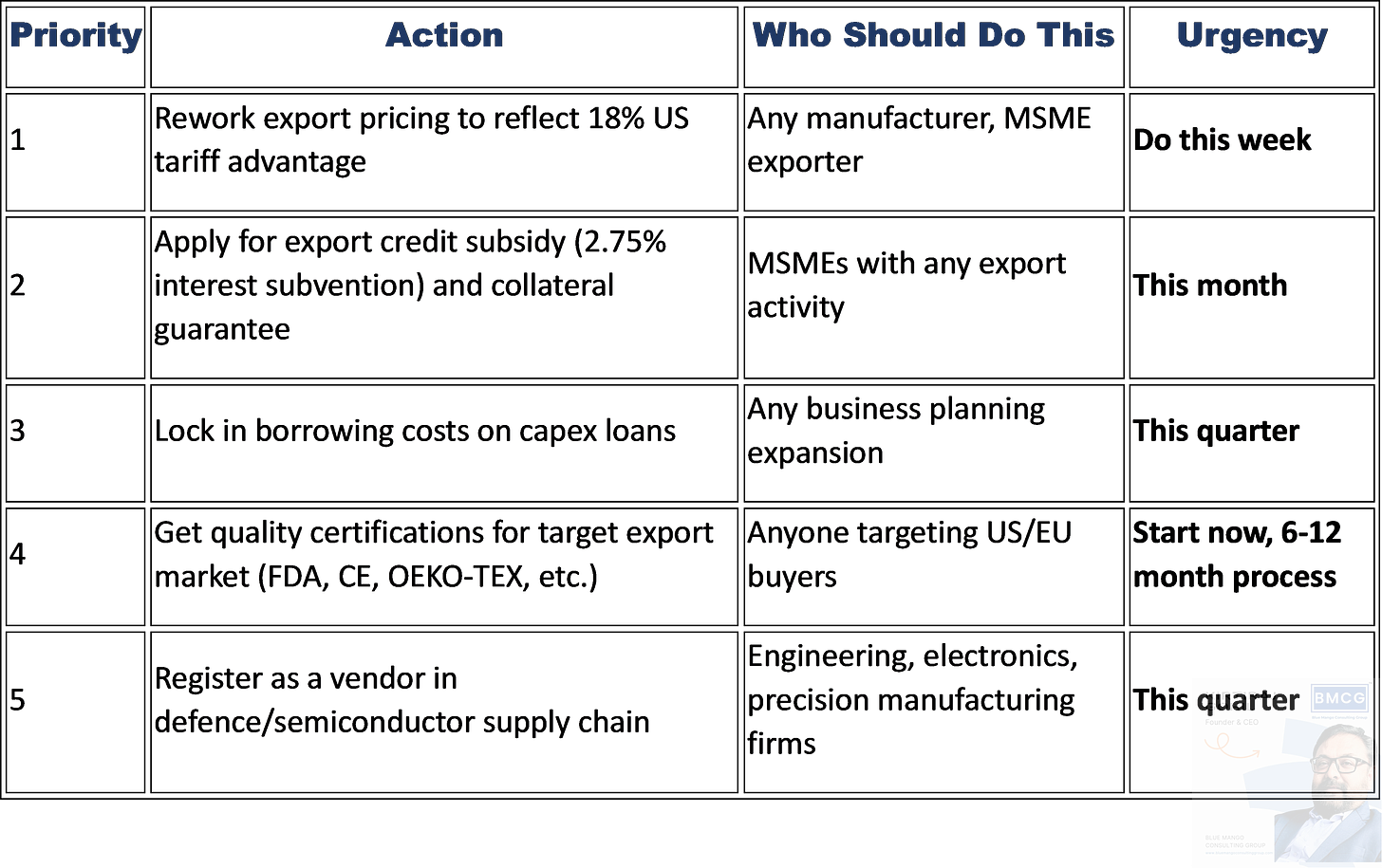
Summary: Top 5 Actions for This Quarter
Disclaimer: Kirtiraj Gohil is a Management Consultant and Founder of Blue Mango Consulting Group. You are advised to do your own analysis and exercise discretion before taking any investment or personal decision. This is an indicative article based on sources cited throughout from Reuters, Trading Economics, White House statements, RBI policy releases, NSDL FPI data, LSEG Lipper fund flow data, IBEF, PIB government releases, PwC/KPMG budget analyses, Goldman Sachs research, JP Morgan Asset Management, Morgan Stanley, Franklin Templeton, and other institutional-grade publications. This does not constitute advice of any kind.