

How Global Uncertainty is Rewriting Consumer Behaviour in 2026
The rise of the Deliberate Spender.
Picture Rajesh Sharma in Indore, a mid-level IT manager in a Tier-2 city. Six months ago, during Diwali sales, he would have impulse-bought the flashiest smartphone on offer. In March 2026, with headlines screaming Middle East tensions and office chatter about delayed appraisals, he did something different. He spent 40 minutes cross-checking 50+ reviews on three e-commerce apps, prioritized a mid-range model with a documented three-year battery warranty, and walked away from the trendier flagship. “It has to last,” he explained to his wife. “We’re saving for the kids’ education—and who knows what the job market will look like next quarter.”
Rajesh is not an outlier. He is the new normal. The hypothesis before us—“Discretionary spending is slowing as uncertainty from global tensions and job insecurity pushes households toward savings and essential spending. Consumers are not stopping purchases entirely but are becoming more deliberate—prioritizing value, durability, and utility over impulse or trend-driven consumption”—is real and partially validated in 2026. We call this “The Value Vigilance Shift.”
1. The Value Vigilance Shift – Real, Partial, and a Mix of Cyclical and Structural Forces: Recent data paints a clear but nuanced picture. In India, March 2026 UPI transaction data showed grocery and dairy volumes rising while beauty, dining-out, and fast-fashion categories pulled back sharply. Credit-card average ticket sizes declined, and listed apparel retailers reported uneven demand—premium segments holding, mass segments selective.
BCG’s December 2025 survey still showed India as the world’s most optimistic consumer market, with 60% of households planning higher spending in the next six months—driven partly by inflation but also by genuine category confidence in autos and mobiles. Yet by Q1 2026, that optimism met reality: global tensions (US-Iran escalation, trade-policy uncertainty) and softening job-market signals triggered the very caution the hypothesis describes.
Globally, McKinsey’s mid-2025 State of the Consumer report documented widespread “trading down” across categories, with 79% of respondents doing so—even while splurging selectively elsewhere. World Bank and IMF January 2026 outlooks flagged slowing global growth (2.6% in 2026) amid trade frictions and geopolitical risk, with consumer sentiment turning negative in developed markets and cautious in emerging ones.
Verdict: The shift is real but partial. Spending has not collapsed—India’s overall private final consumption expenditure still grew ~6% in late FY25—but the composition has changed dramatically. Impulse and trend purchases are down; planned, utility-focused buys are up. Media narratives of “doom and gloom” overstated the slowdown in early 2025, but Q1 2026 data validated the pivot.
**Cyclical or structural?**Both. The current caution is cyclical—tied to 2025–26 geopolitical flare-ups and job-market jitters. But the deeper move toward value, durability, and proof-of-utility is structural, accelerated by digital transparency and a generation that grew up post-COVID watching household balance sheets strain.
2. Consumer Behavior Shift Matrix
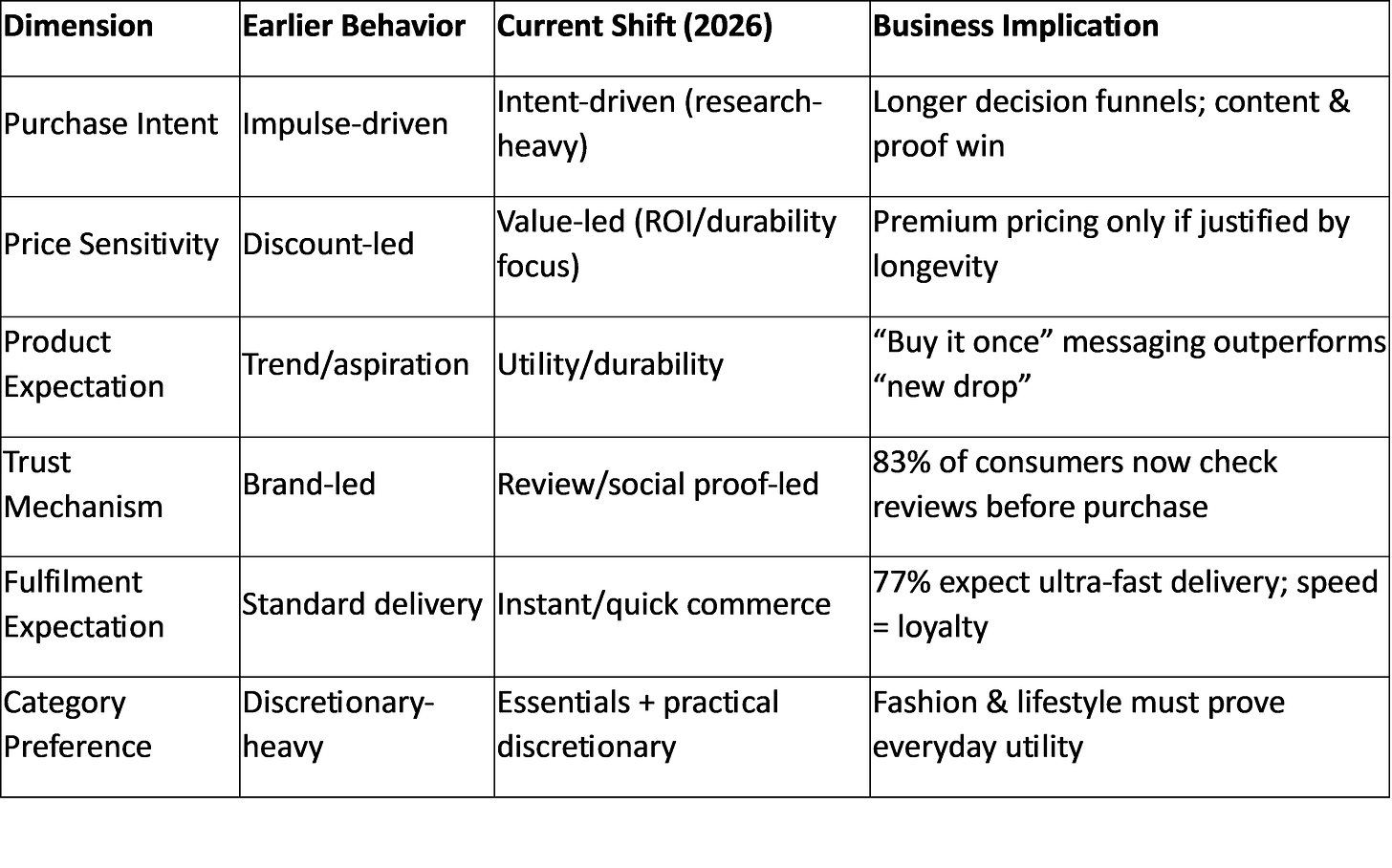
Tier-wise split
- Metro/Tier-1 : Still premium-value seekers; willing to pay for smart/durable features but demand transparency.
- Tier-2/3/4 towns : Explosive growth in practical discretionary via quick commerce (66% of new D2C orders in FY26 from these cities). They want reliability at accessible price points.
Income-segment split
- Mass : Extreme value-led; small packs, proven durability.
- Aspirational : Durability + status-lite (e.g., “lasts 5 years and looks good”).
- Premium/HNI : Purposeful luxury—experiences and products with clear long-term ROI or sustainability proof. Hype alone no longer suffices.
3. Demand Reconfiguration Analysis: Category-Wise Impact
Fashion & Apparel: ↓ (planned, slower). Consumers selective; demand for versatile, durable pieces up, pure trend pieces down. Margin pressure high—discounting fatigue evident.
Lifestyle & Luxury: Stable but slower / selective splurge. Experiential luxury (travel, wellness) holding better than goods; “luxury without purpose” struggling.
FMCG & Essentials: ↑ or stable (volume resilient). Mass-premium and health-focused SKUs winning; small packs driving frequency.
Electronics & Durables: Mixed ↑ in planned replacement. Consumers buying fewer but better-spec’d, longer-lasting items (smart features justified only if they deliver measurable utility).
E-commerce & Quick Commerce: ↑ sharply. India’s e-retail hit ~$65–66B GMV in 2025 and is accelerating into 2026, with quick commerce now penetrating 80+ Tier-2/3 cities. Speed and review-driven discovery are the new battleground.
4. Who Wins vs Who Needs to Change
Winners
- Brands proving clear ROI/value (durability warranties, bundled utility).
- Players offering speed + reliability (quick-commerce-native or omnichannel).
- Those building trust architecture—authentic reviews, transparency, social proof.
- D2C and value-led premium players riding the Tier-2/3 wave.
At Risk
- Pure hype/trend-driven brands.
- Heavy discounters with no differentiation.
- Slow-fulfilment players.
- “Luxury without purpose” offerings that feel aspirational but deliver no lasting utility.
5. Business Action Framework
For All Businesses
- Shift messaging from “newness” to “long-term value & durability.”
- Build trust architecture: surface reviews early, offer transparent warranties, leverage user-generated proof.
- Optimize unit economics for slower, higher-intent conversion cycles.
For Consumer-Facing Businesses
- Introduce value bundles and durable product lines.
- Launch or strengthen subscription/repeat models for essentials and practical discretionary.
- Invest aggressively in quick-commerce/logistics partnerships—especially for Tier-2/3 expansion.
- Reduce over-reliance on discounting; replace with proof-of-value campaigns.
- Go omnichannel: seamless review-to-delivery experience.
6. Q1 & Q2 2026 Forward Outlook
Base case: Revenue growth lags volume slightly as consumers buy fewer but higher-quality items. Margin pressure moderate; inventory cycles lengthen in fashion/lifestyle. Demand elasticity rises—price hikes tolerated only with clear justification.
Best case (de-escalation of tensions + strong rural monsoon): Discretionary rebounds modestly by Q2; quick commerce and value-premium categories surge 20%+.
Worst case (escalating geopolitics + job-market deterioration): Further 5–8% discretionary contraction; heavy discounting returns, squeezing margins 200–300 bps.
Inventory discipline will be make-or-break—especially in apparel, where overstock risk is highest.
7. Digital & Decision Behavior Shift
83% of consumers now check reviews before purchase; 77% expect ultra-fast delivery. The purchase funnel has flipped: awareness-to-consideration is now validation-driven. Ads still matter for discovery, but social proof and quick-commerce convenience close the deal. Intent commerce—search + review + 10-minute delivery—is the new default, particularly in Tier-2/3 towns where quick commerce has become infrastructure, not novelty.
How Blue Mango Consulting Group Helps Businesses Navigate This Shift
At Blue Mango Consulting Group, we do not offer generic advice. We translate these consumer insights into precise revenue strategies. We design value-led positioning frameworks that turn durability and utility into competitive moats. We build customer-experience and trust systems that convert the 83% review-checkers into loyal repeat buyers. We enable go-to-market transformations that marry quick-commerce speed with omnichannel depth. And through our international networks, we support brands expanding beyond India while staying rooted in this new value vigilance.
The era of the deliberate spender is here. Businesses that treat it as a temporary blip will lose share. Those that re-engineer around value, proof, speed, and utility will not only survive 2026—they will define the decade.
The cart is no longer impulsive. It is intentional. The winners are already building for the consumer who, like Rajesh in Indore, has decided to buy less, but buy better—and expects you to prove it.