

The Mechanical Bull | India's SIP Machine
How India’s Mutual Fund Machine Is Rewriting Market Structure — And Its Challenges
An Analysis of Structural Risks, Behavioural Underpinnings, Tipping Points, and Historical Precedents in India’s SIP-Driven Equity Market
Executive Summary
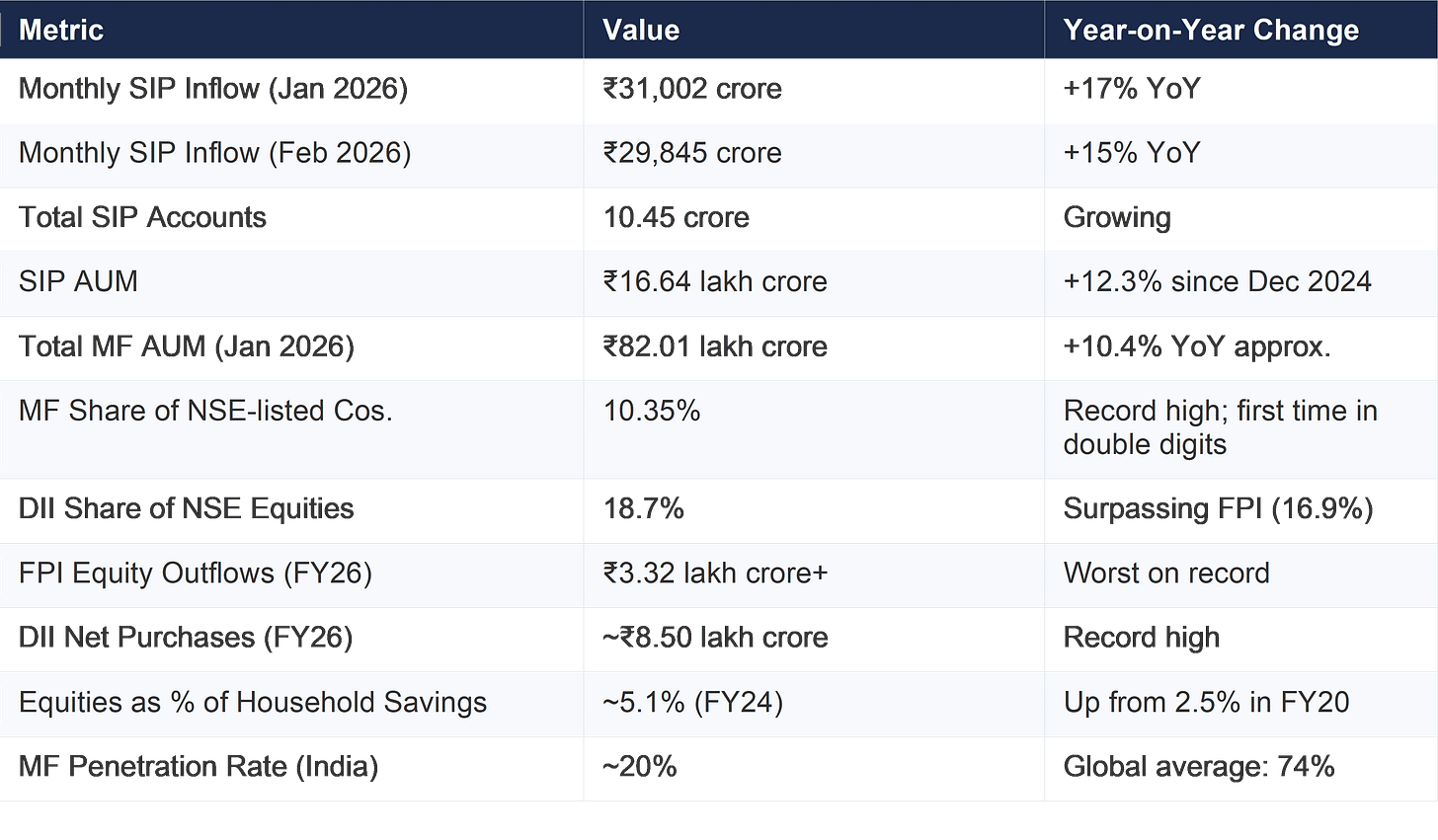
India’s stock market is operating under a structural condition that has no close parallel among major global equity markets. A mechanical, non-discretionary buying machine — powered by Systematic Investment Plan (SIP) inflows into domestic mutual funds — has created a persistent, automatic bid under equities regardless of valuations, earnings trajectories, or global macroeconomic conditions. Monthly SIP contributions exceeded ₹31,000 crore in January 2026, and total mutual fund AUM has crossed ₹82 lakh crore. Domestic institutional investors now hold a larger share of NSE-listed equities (18.7%) than foreign portfolio investors (16.9%), a reversal of a decades-old structural hierarchy.
This paper presents a balanced assessment. The bull case for India is genuine: 6.5–7.5% GDP growth, a favourable demographic profile, structural formalisation, and a digital infrastructure revolution provide legitimate long-term support for equity valuations. Dollar-cost averaging through SIPs has historically delivered strong risk-adjusted returns for disciplined investors, and the mechanism has admirably absorbed record foreign outflows without a systemic crisis.
However, this paper argues that the current structure carries specific risks that are underappreciated. The SIP mechanism has not eliminated the fundamental risks inherent in equity investing; it has concentrated and deferred them. The extraordinary stickiness of SIP flows is built substantially on behavioural foundations — status-quo bias, auto-debit inertia, and one-directional framing by the advertising ecosystem — rather than on informed, deliberate asset allocation. When these behavioural foundations are eventually tested by a sustained bear market, the same forces that maintained flows on the way up may amplify outflows on the way down.
This analysis identifies specific tipping points and hard limits, acknowledges the strengths of the current system, examines the behavioural architecture, and provides a scenario framework for strategic planning. It is intended for corporate decision-makers, institutional allocators, and policy advisors who need to understand the range of outcomes, not a single directional call.
1. The Mechanism: How the SIP Machine Works
1.1 The Structural Bid
India’s mutual fund industry has engineered something genuinely novel in global capital markets: a recurring, automatic equity purchase mechanism that operates independently of investor sentiment, market conditions, or fundamental valuations. SIP investors commit a fixed amount monthly, which is auto-debited and deployed by fund managers into equities according to their mandate. The fund manager cannot refuse to deploy this capital; sitting on excessive cash would cause them to underperform their benchmark.
The scale of this mechanism is now enormous. SIP inflows reached ₹31,002 crore in January 2026 and ₹29,845 crore in February 2026, representing year-on-year growth of approximately 15%. The total number of SIP accounts has crossed 10.45 crore, with SIP AUM reaching ₹16.64 lakh crore. The total mutual fund industry AUM stood at approximately ₹82 lakh crore as of early 2026, with domestic mutual funds holding a record 10.35% share of all NSE-listed companies — the first time this figure has reached double digits.
1.2 The FPI Counterbalance Dynamic
The most visible effect of this mechanism has been its ability to absorb massive foreign institutional selling. Foreign portfolio investors were net sellers of Indian equities worth over ₹3.32 lakh crore through much of FY26, driven by rising US rates, dollar strength, rupee depreciation, and the West Asia conflict that escalated in late February 2026. FPI ownership in NSE-listed equities fell to 16.9% in Q2 FY26, a 15-year low. Despite this, domestic institutional investors purchased approximately ₹8.50 lakh crore worth of stocks during FY26, effectively counterbalancing the foreign exit.
This has meaningfully altered the traditional price-discovery dynamic. Historically, foreign portfolio flows acted as the marginal pricing signal in Indian equities, reflecting global risk appetite and relative valuation assessments. That signalling function has been substantially diluted. The market increasingly reflects the mechanical deployment of domestic savings rather than the weighted judgment of global capital.
1.3 The Price-Discovery Concern
A healthy equity market requires two-way price discovery, where buyers and sellers express genuine views on intrinsic value. When one side has an effectively mechanical, non-discretionary bid, certain distortions can emerge. Valuations may disconnect from underlying earnings and cash flow reality, because prices reflect the volume of flow rather than fundamental analysis. Realised volatility can be suppressed below the level that the underlying risk environment would justify, potentially leading to an underpricing of risk across the system.
It is important to note what this is not: this is not a leverage-driven feedback loop of the kind George Soros described in his theory of reflexivity, where rising asset prices enable more borrowing which enables more buying. SIP flows are savings-funded, not debt-funded, and this distinction is critical. The appropriate analytical framework is closer to what Robert Shiller describes as narrative economics — where investment flows are driven by prevailing stories (“equities always win in the long run,” “India’s growth story”) rather than by continuous fundamental reassessment. The risk is not a leverage unwind but a narrative unwind — slower-moving but potentially equally consequential over time.
2. The Bull Case: What the Optimists Get Right
Before examining the risks, intellectual honesty requires acknowledging that the structural case for Indian equities is not manufactured. Several fundamental factors support long-term equity allocation to India, and the SIP mechanism has delivered genuine value to millions of investors.
2.1 The Macroeconomic Foundation Is Real
India’s GDP grew at 7.6% in FY26 — the fastest pace in recent years among major economies. The economy benefits from a demographic dividend (median age approximately 28, compared to 38 in China and 47 in Japan), rapid formalisation of economic activity through GST and digital payments (UPI transactions reached 185.9 billion in FY25), and an expanding middle class. India received credit rating upgrades from global agencies during 2025. These are not narrative constructions; they are measurable structural advantages that justify a premium for Indian equities relative to many emerging markets.
2.2 Dollar-Cost Averaging Works — The Data Confirms It
The theoretical justification for SIP investing is dollar-cost averaging (DCA): by investing a fixed amount at regular intervals regardless of market conditions, the investor buys more units when prices are low and fewer when prices are high, resulting in a lower average cost per unit over time. This is not merely a marketing claim — it is a mathematically sound investment principle with extensive empirical support.
A 30-year backtest of the Indian market (1995–2025, Nifty index) demonstrates the principle’s validity. A pure monthly SIP of ₹10,000 delivered a terminal value of approximately ₹3.38 crore and a CAGR of roughly 12.48%. An annual lump-sum strategy that invested only on 10% dips delivered approximately ₹3.9 crore at 12.41% CAGR. A hybrid approach produced nearly identical results. The difference between all three strategies was statistically negligible over the 30-year period. This confirms that the SIP mechanism’s core design — removing timing decisions and enforcing discipline through automation — is sound investment engineering.
2.3 The Stickiness Is a Feature, Not Just a Bug
Much of this paper examines how behavioural inertia sustains SIP flows. But it must be acknowledged that this stickiness has been overwhelmingly beneficial to investors so far. The 51 consecutive months of positive equity mutual fund net inflows through mid-2025 meant that investors who maintained their SIPs through the 2022 correction, the 2024 volatility, and the FPI-driven selloff of late 2025 accumulated units at lower prices and benefited from the subsequent recovery. The auto-debit mechanism prevented millions of investors from making the classic behavioural error of selling at the bottom and buying at the top. In this sense, the “autopilot” is not a flaw — it is the system working as designed.
2.4 The Penetration Runway
India’s mutual fund penetration rate stands at approximately 20%, compared to a global average of 74%. The number of demat accounts has crossed 200 million, but the vast majority of India’s 1.4 billion people remain outside formal equity markets. As incomes rise, financial literacy improves, and digital infrastructure reaches deeper into semi-urban and rural India, there is a legitimate structural case that SIP flows have significant room to grow before reaching saturation. Equities as a percentage of household savings have moved from 2.5% in FY20 to approximately 5.1% in FY24 — a remarkable shift, but still well below developed-market levels.
The bull case is not wrong. India’s fundamentals are strong, DCA is mathematically sound, and the SIP mechanism has delivered genuine value. The question is not whether these things are true — they are. The question is whether these truths are sufficient to justify current valuations and whether the risks arising from the mechanism’s scale and behavioural architecture are being adequately priced.
3. The Behavioural Architecture: Why the Machine Is Extraordinarily Sticky
The structural dominance of SIP flows in Indian equity markets cannot be explained by financial logic alone. It requires an understanding of the behavioural engineering that underpins the system. The SIP mechanism is one of the most effective applications of behavioural finance principles deployed at national scale — a system that exploits well-documented cognitive biases to keep money flowing in a single direction.
3.1 The Autopilot Effect: Set-and-Forget Investing
The typical SIP investor in India is a salaried, middle-class individual who sets up a monthly auto-debit of ₹5,000 to ₹25,000 via a mobile application in approximately two minutes. From that moment, the investment runs on pure autopilot. There is no monthly decision point, no timing call, no emotional override. The auto-debit executes on a fixed date regardless of whether the Nifty is at 25,000 or 18,000, regardless of whether the investor has read any market news, regardless of whether they have thought about their portfolio at all since initial setup.
As noted in Section 2, this autopilot is precisely why the mechanism works — it prevents the emotional errors that destroy returns for active traders. But it simultaneously means that a large portion of the flow represents passive continuation rather than active conviction. The same mechanism that prevents panic selling during corrections also prevents rational reallocation when valuations become extreme or when an investor’s life circumstances change.
This is textbook behavioural finance in action. The mechanism exploits three well-documented cognitive biases simultaneously.
Status-Quo Bias
Once a SIP is activated, continuing it requires zero effort while stopping it requires conscious action. The behavioural economics research of Samuelson and Zeckhauser (1988) established that people overwhelmingly prefer the current state of affairs when the cost of changing is even marginally higher than the cost of staying put. For a SIP investor, “doing nothing” means the investment continues automatically. Stopping requires logging into an app, navigating to SIP management, selecting the SIP, confirming cancellation, and psychologically accepting that they are “quitting” an investment. That friction, however small, keeps millions of SIPs alive that would not survive a monthly active decision.
Default Effect and Choice Architecture
The mutual fund and fintech ecosystem has brilliantly engineered the “default” to be continued investment. Thaler and Sunstein’s foundational work on nudge theory demonstrates that defaults are extraordinarily powerful. In the United States, automatic enrolment in 401(k) retirement plans increased participation rates from roughly 60% to over 90%. India’s SIP auto-debit operates on the same principle, with one crucial structural difference: US 401(k) auto-enrolment typically defaults into balanced, age-adjusted target-date funds (e.g., 60/40 equity/debt for a young investor, shifting to 20/80 near retirement). Indian SIPs overwhelmingly default into pure equity funds. This means the Indian mechanism channels a larger proportion of automated household savings into equities than its closest US equivalent, concentrating risk rather than diversifying it.
Inertia and Cognitive Load Avoidance
The modern Indian salaried professional is cognitively overloaded: EMIs, rent, school fees, insurance premiums, tax-saving deadlines, and daily expenses all compete for mental bandwidth. The SIP is designed to require zero cognitive load after initial setup. This is not a minor design choice — it is the primary reason SIP flows are structurally stickier than most forms of equity investment elsewhere in the world. Lump-sum investors in the US, Europe, or other Asian markets must make an active buy decision each time, which means each purchase passes through an emotional and analytical filter. SIP investors skip this filter entirely, month after month, year after year.
The critical nuance: SIP stickiness is both the mechanism’s greatest strength and its greatest vulnerability. It prevents destructive emotional trading during normal corrections (a genuine benefit), but it also means that the system has never been meaningfully stress-tested — the autopilot has operated almost exclusively in favourable conditions. We do not yet know how sticky the machine is when the environment turns genuinely hostile.
3.2 The Alternatives Landscape: Real Gaps and Perceived Gaps
A fundamental question arises: if SIP stickiness is partially driven by inertia and zero-friction automation, why don’t investors redirect those same automatic flows into alternative asset classes? The answer is more nuanced than “there are no alternatives” — alternatives exist, but they differ critically in friction, narrative support, and distribution reach.
Gold: Available but Under-Distributed
Gold has historically been the Indian household’s default savings vehicle, and in 2025 it delivered extraordinary absolute returns of approximately 67–69%, massively outperforming equities. Gold mutual funds and gold ETFs do allow SIP investment — the zero-friction automation technically exists. However, the distribution and advertising machinery promoting gold SIPs is a fraction of what exists for equity SIPs. Gold mutual funds collectively represent a tiny fraction of total gold demand in India, where the vast majority of gold investment remains physical, episodic, and culturally-timed (Dhanteras, Akshaya Tritiya, weddings). Sovereign Gold Bonds offered an attractive structure but had an 8-year lock-in and the RBI has discontinued new issuances. The gap is not in product availability but in ecosystem completeness — marketing reach, social proof, distributor incentives, and fintech platform prominence.
Real Estate: Structurally Inaccessible via Auto-Debit
Real estate remains the largest component of Indian household savings at approximately 12.9% of GDP, dwarfing net financial savings at 5.3%. But real estate investment is inherently lumpy, illiquid, and inaccessible through a monthly automated mechanism. REITs exist but remain a niche product with low retail penetration. Fractional real estate platforms have emerged but lack the regulatory standardisation, brand trust, and distribution reach of mutual funds. No salaried professional can auto-debit ₹10,000 per month into a diversified real estate portfolio with the same ease as an equity SIP. This is a genuine structural gap, not merely a perception issue.
Fixed Income: Available, De-Prioritised, and Capped
Bank fixed deposits, debt mutual funds, PPF, NPS, and small savings schemes all technically exist as alternatives, some with auto-debit facilities. PPF allows standing instructions at banks; NPS supports auto-debit. But several factors have de-prioritised these. RBI rate cuts have reduced FD returns to levels that barely outpace inflation. PPF is capped at ₹1.5 lakh annually. NPS is perceived as complex and illiquid. Most critically, the dominant narrative in the financial ecosystem — amplified by distributors, fintech platforms, and social media — consistently frames fixed-income products as inferior to equities for long-term wealth creation. While this framing is directionally supported by historical data, it systematically discourages diversification.
Direct Equity: Higher Friction, Different Risk Profile
India has seen an explosion of demat accounts, crossing 200 million by mid-2025. But direct equity investing requires active research, stock selection, timing decisions, and emotional management. SEBI data shows that individual F&O traders suffered net losses of approximately ₹1.06 lakh crore in FY25 alone. The SIP investor is, in a very real sense, outsourcing the investment decision to a professional fund manager and an auto-debit mandate simultaneously. Direct equity is a complement for the financially engaged minority, but it does not serve the same function as the autopilot SIP for the passive salaried investor.
The structural reality: the equity SIP dominates not because no alternatives exist, but because no alternative combines (a) zero-friction monthly automation, (b) a compelling return narrative, (c) a massive distribution and advertising ecosystem, and (d) overwhelming social proof at the same scale. The alternatives are real but under-distributed. The equity SIP’s dominance is a function of ecosystem completeness, not product superiority.
3.3 The Advertising Ecosystem: One-Directional Framing
The stickiness of SIP flows cannot be separated from the enormous advertising and distribution machinery that sustains them. India’s mutual fund industry invests heavily in advertising, and the messaging has been effective in embedding a set of beliefs that function as self-reinforcing frameworks. It is important to assess these narratives honestly: they are not false, but they are materially incomplete.
The Three Core Narratives
**Narrative One: “Mutual Funds Sahi Hai.”**This AMFI campaign, running since 2017, has achieved something remarkable: it has turned a financial product category into a social norm. The framing is absolute, not conditional. It does not say “mutual funds may be suitable depending on your risk profile, time horizon, and alternative options.” It says mutual funds are correct. To be fair, the underlying message — that professionally managed, diversified equity exposure is a sound long-term wealth creation strategy — is supported by historical evidence. But for a first-generation investor who may not have the financial literacy to evaluate asset allocation trade-offs, the social proof embedded in a nationally televised campaign can substitute for independent analysis.
**Narrative Two: “SIP karo, bhool jao.”**Start your SIP and forget about it. This is not merely a tagline; it is an explicit instruction to disengage from active evaluation of the investment. The message directly encourages the autopilot behaviour described above. Here, the assessment is genuinely mixed. On one hand, the advice is sound for most investors — the evidence consistently shows that frequent monitoring and trading destroys returns. On the other hand, “forget about it” also means “don’t reassess your asset allocation, don’t adjust for changed life circumstances, don’t consider whether your risk profile has shifted.” It reframes inertia — which is a cognitive limitation — as a virtue, and while this framing is beneficial in most market environments, it creates complacency about genuine risks.
**Narrative Three: “Time in the market beats timing the market.”**This principle is statistically valid over long time horizons, as confirmed by the 30-year backtest data cited in Section 2. But it is deployed in industry communication as a universal truth that absolves investors of any responsibility to assess valuations, macro conditions, or portfolio concentration. It is used to pre-empt any impulse to reduce equity exposure, regardless of how elevated valuations may be. The practical effect is to create a one-way ratchet: money flows in during bull markets because returns are attractive, and money stays in during corrections because “time in the market” is invoked as a reason not to leave. What the narrative omits is that Japan’s Nikkei, the US NASDAQ post-2000, and several other markets have had periods where “time in the market” over 10–15 years delivered negative real returns.
The Distribution Incentive Structure
Behind the advertising sits a network of approximately 1.2 lakh mutual fund distributors (MFDs) and a growing universe of fintech platforms (Groww, Zerodha, Paytm Money, ET Money, and others). Distributors earn trail commissions on regular-plan AUM for as long as the investor remains invested. This creates a structural incentive to encourage new SIP registrations and discourage cancellations. The distributor’s financial interest is aligned with flow continuation and misaligned with any recommendation to reduce equity exposure, book profits, or shift to alternative asset classes. This is not unique to India — commission-based distribution structures create similar conflicts globally — but the scale of India’s SIP-driven flows makes the incentive structure systemically significant.
Approximately 40% of SIP accounts are now in direct mode via fintech platforms, accounting for nearly 46–47% of industry AUM. Data indicates this segment shows disproportionately higher SIP stoppages, shorter holding periods, and greater portfolio churn — suggesting that the ease of onboarding is matched by an ease of exit that may behave differently in a sustained downturn than the traditional distributor-mediated channel.
3.4 The Honest Assessment: Inertia, Gaps, and Incomplete Information
The SIP machine’s stickiness is sustained by three forces operating simultaneously and reinforcing each other.
**It is inertia.**The auto-debit mechanism eliminates every decision point where an investor might reconsider. Research on 401(k) participation in the US shows that even a minor increase in friction required to change a default reduces the rate of change by 50–70%. The SIP auto-debit exploits this same dynamic. This is both a feature (preventing emotional errors) and a vulnerability (preventing rational reassessment).
**It is a genuine ecosystem gap.**While alternative products exist (gold SIPs, NPS auto-debit, PPF standing instructions), none has the same combination of distribution reach, advertising spend, social proof, and fintech integration as the equity SIP. The product ecosystem is structurally tilted toward equities not because equities are necessarily the optimal allocation for every household, but because the equity product infrastructure is years ahead of everything else in marketing completeness.
**It is one-directional framing.**The industry’s advertising narratives are not false — long-term equity investing is sound, DCA works, and impulsive timing destroys returns. But they are materially incomplete. They do not present trade-offs, do not discuss the possibility of extended periods of negative real returns, do not encourage diversification across asset classes, and do not acknowledge that equity concentration risk increases as SIP AUM grows relative to market capitalisation. For first-generation investors who lack independent financial literacy, this incomplete information effectively makes the asset allocation decision for them.
**And it is reinforced by social proof.**When your colleague, your cousin, your WhatsApp group, and your Instagram feed all discuss SIP returns, the social cost of not participating becomes higher than the perceived financial cost of participating. This is herding behaviour, documented extensively in the behavioural finance literature, operating at a scale of over 100 million SIP accounts.
The strategic implication: the SIP machine’s stickiness is built on a combination of genuine investment merit (DCA works), behavioural inertia (defaults are powerful), ecosystem advantage (distribution reach), and incomplete information (one-directional framing). The first two are stabilising forces. The last two are fragile. When behavioural conditions change — when losses become large enough to override inertia, when a competing narrative gains social traction, when “bhool jao” begins to feel reckless rather than wise — the fragile components will crack first, and the question is whether the genuine components are strong enough to hold.
4. The Data Picture: Scale and Trajectory
4.1 Key Flow Metrics (FY26)
4.2 SIP Stoppage: The Early Warning Signal
While headline SIP inflow numbers remain robust, the SIP stoppage ratio — the ratio of discontinued or tenure-completed SIPs to newly registered SIPs — has shown concerning elevation. This metric measures the rate at which behavioural inertia is being overcome by negative experience or changed circumstances, making it the single most important leading indicator for flow sustainability.
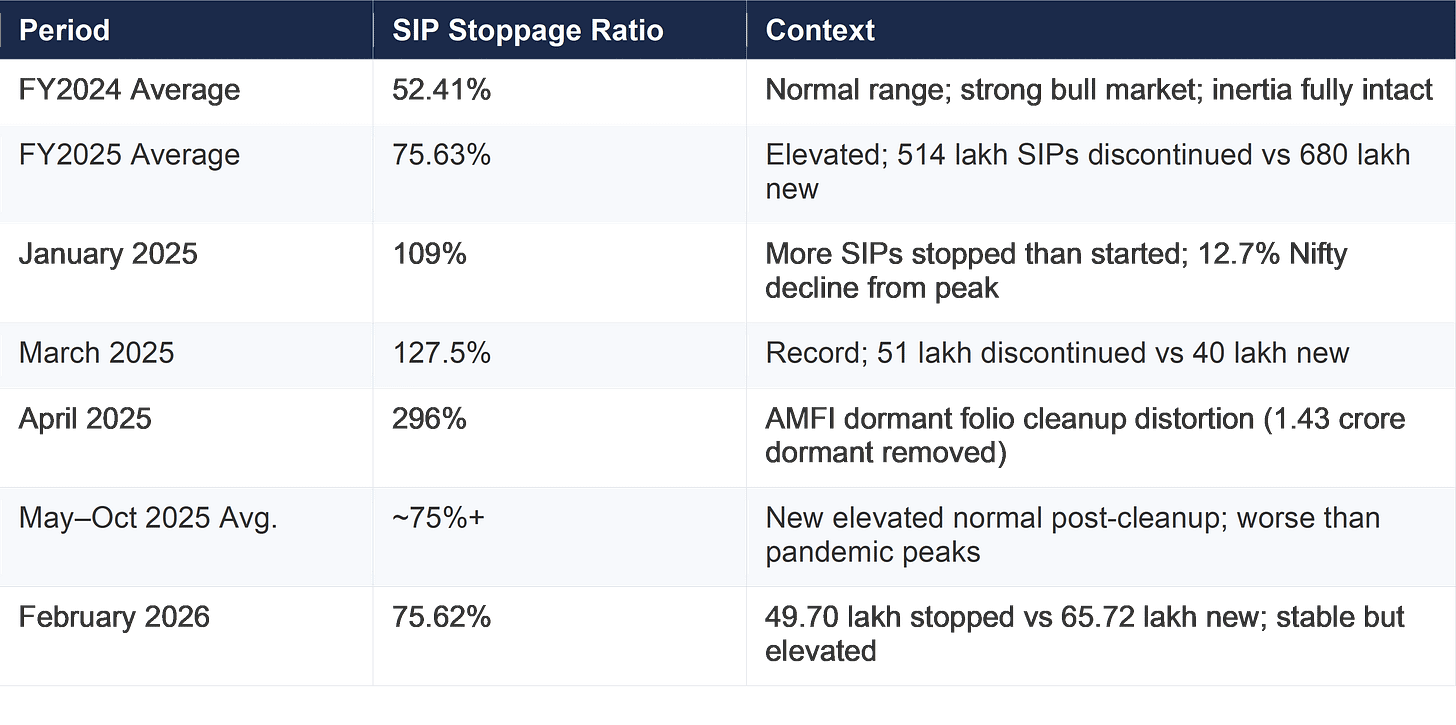
A critical observation demands attention: a drawdown of only 12–13% from the Nifty’s peak was sufficient to push SIP stoppages above 100% in January 2025. This has two interpretations. The optimistic reading is that the spike was temporary and flows normalised within months, demonstrating the system’s resilience. The cautionary reading is that if even a moderate correction cracked inertia for a meaningful subset of investors, a deeper and more sustained drawdown could trigger a cascade effect. Both readings have merit. What is beyond dispute is that the SIP mechanism has never been tested against a 25–30% sustained drawdown lasting more than two quarters. The behavioural threshold at which inertia comprehensively breaks remains empirically unknown.
5. The Five Tipping Points: Where the Machine Breaks
5.1 Tipping Point One: Redemption Pressure Exceeding Inflows
SIPs are voluntary and cancellable at any time. The stickiness observed so far has been during relatively mild corrections of 10–15%. The untested scenario is a prolonged bear market of 30–40% sustained over 12–18 months. The behavioural dynamics described in Section 3 suggest that inertia operates on a gradient, not a cliff-edge: small corrections leave the autopilot intact, moderate corrections cause elevated stoppage ratios (as seen in January 2025), and a severe, prolonged drawdown could overwhelm inertia entirely.
If and when net flows turn negative, the same mechanism that mechanically bought on the way up would mechanically force selling on the way down, because fund managers must liquidate holdings to meet redemption obligations. The mid-cap and small-cap segments, where MF concentration is highest and liquidity is thinnest, would be most severely affected. Impact costs would spike, potentially creating a negative feedback loop where forced selling drives prices lower, triggering further redemptions. It is important to note, however, that this feedback loop operates through liquidity rather than leverage, which means it is slower-moving and more amenable to regulatory intervention (trading halts, redemption gates) than a leverage-driven unwind.
5.2 Tipping Point Two: A Genuine Earnings Recession
Indian equity markets are priced for sustained 15%+ earnings growth. If two or three consecutive quarters deliver broad-based earnings downgrades across multiple sectors — triggered by a global demand slowdown, a domestic consumption shock from high oil prices and inflation, or a credit event — the fundamental underpinning of current valuations erodes. Fund managers can tolerate deploying capital into expensive markets as long as they can argue that earnings will eventually catch up. When forward estimates are being cut, even the most bullish fund manager begins raising cash defensively.
The current macro environment carries specific risks. Brent crude crossed $110/barrel following the West Asia conflict. The rupee has depreciated over 11% in FY26, hitting a record low of ₹93.94 per dollar. RBI’s inflation projection for FY27 is 4.6% with a Q3 peak of 5.2%. If these pressures persist, corporate margins will compress and the earnings growth assumption underpinning valuations will erode. However, it should be noted that India’s underlying GDP growth trajectory (6.5–7.5%) and structural formalisation trends provide a degree of earnings resilience that many other emerging markets lack.
5.3 Tipping Point Three: A Liquidity or Credit Crisis
This is the hard stop. If a systemic event materialises — a large NBFC failure, a banking crisis arising from asset quality deterioration, or a sudden rupee depreciation forcing RBI into aggressive monetary tightening — redemption pressure can spike overnight. The IL&FS crisis of 2018 and the Franklin Templeton episode of 2020 demonstrated that even institutional-grade financial products can face liquidity crises. If a comparable event hit equity-heavy MF portfolios, the resulting confidence shock could trigger a rush for exits that overwhelms SIP inflows.
The particularly dangerous scenario is when a credit event coincides with already-elevated oil prices, a weakening rupee, and FPI outflows — conditions that are partially in place as of April 2026.
5.4 Tipping Point Four: Regulatory Intervention
SEBI has wide-ranging authority to impose restrictions on mutual fund portfolio construction, mandate higher cash buffers, tighten categorisation rules, or introduce measures that mechanically force rebalancing. SEBI’s 2018 recategorisation exercise forced significant portfolio reshuffling. A future round of stricter rules on sectoral concentration, mid/small-cap exposure caps, or liquidity stress testing requirements could create selling pressure independent of investor sentiment.
5.5 Tipping Point Five: Demographic and Savings Rate Ceiling
India’s financial savings flowing into equities have grown dramatically, but there is a natural ceiling. If household savings rates decline — due to inflation eroding real incomes, rising EMI burdens, or a preference shift toward gold and real estate (both of which have rallied significantly) — SIP flow growth will decelerate. Even a deceleration in flow growth (not a reversal) would remove the marginal bid that has supported valuations beyond fundamental levels. The 20% MF penetration rate versus the 74% global average is often cited as evidence of runway, but it also reflects structural realities: large portions of India’s population are not yet in a position to make discretionary financial investments, and the investable segments in major metros may be approaching saturation.
6. Historical Precedents: Lessons and Limitations
Historical analogies inform risk assessment but must be applied carefully. Each precedent below offers specific lessons while differing from India’s current situation in important ways.
6.1 Japan, 1989–1990: Narrative Collapse
The Nikkei peaked at approximately 39,000 in December 1989 and did not recover that level for 34 years. The parallel to India’s current “India is different” narrative is instructive: market narratives hold until they don’t, and when they break, they break completely.
**Critical differences:**Japan’s bubble was fundamentally leverage-driven. Corporate cross-shareholding (keiretsu system), massive bank lending against real estate collateral, and speculative corporate excess created a system where rising asset prices directly enabled more borrowing and more buying. India’s SIP mechanism is savings-funded, not debt-funded. The Bank of Japan’s aggressive monetary tightening burst a credit bubble; India’s MF flows would unwind through a redemption cycle, which is a slower and more manageable process. Additionally, Japan’s demographics had already peaked, while India’s demographic dividend is still in its early phase. The Japanese comparison is instructive on narrative dynamics but structurally overstated as a market-mechanics parallel.
6.2 India, 2008: When Global Tides Override Domestic Flows
Mutual fund equity AUM declined roughly 40% from peak to trough during the 2008 Global Financial Crisis. SIPs were a much smaller component of total flows at that time, but redemptions were severe. The Sensex fell from 21,000 to below 8,000. The lesson remains valid: when a truly global crisis occurs, domestic flows can slow the descent but cannot prevent it. They provide a speed bump, not a floor. However, the current SIP base (₹30,000+ crore monthly) is orders of magnitude larger than in 2008, which means the speed bump is significantly more substantial.
6.3 UTI US-64 Crisis, 2001: Institutional Trust Evaporation
The Unit Trust of India collapsed when its flagship US-64 scheme could not meet redemption pressure. The guaranteed-return structure was fundamentally different from today’s market-linked MF products, and today’s regulatory framework (SEBI oversight, NAV transparency, segregated portfolios) is far more robust. The relevant lesson is narrower but important: retail trust in a large financial institution can evaporate rapidly, and when it does, the contagion extends beyond the specific institution to the entire product category. A comparable confidence shock involving a major AMC could have industry-wide repercussions despite stronger regulation.
6.4 South Korea, 2007–2008: Domestic Flows Amplifying Correction
Korean retail investors were aggressive equity buyers through domestic funds in the 2005–2007 period. When the Global Financial Crisis hit, fund redemptions were so severe that Korean markets fell more sharply than peers despite sound economic fundamentals. The Korean experience demonstrates that concentrated domestic fund flows can amplify, rather than cushion, a correction when the redemption cycle begins — the most direct and relevant precedent for India’s current structure.
6.5 India’s Franklin Templeton Crisis, 2020: Confidence Contagion
When Franklin Templeton wound up six debt schemes in April 2020, the impact extended beyond those schemes to trigger elevated redemptions across the broader mutual fund industry. The episode demonstrated that even a single institutional failure creates contagion through the entire MF ecosystem. A comparable event involving an equity fund house could have significantly larger repercussions given current equity AUM scale.
7. Scenario Framework for Strategic Planning
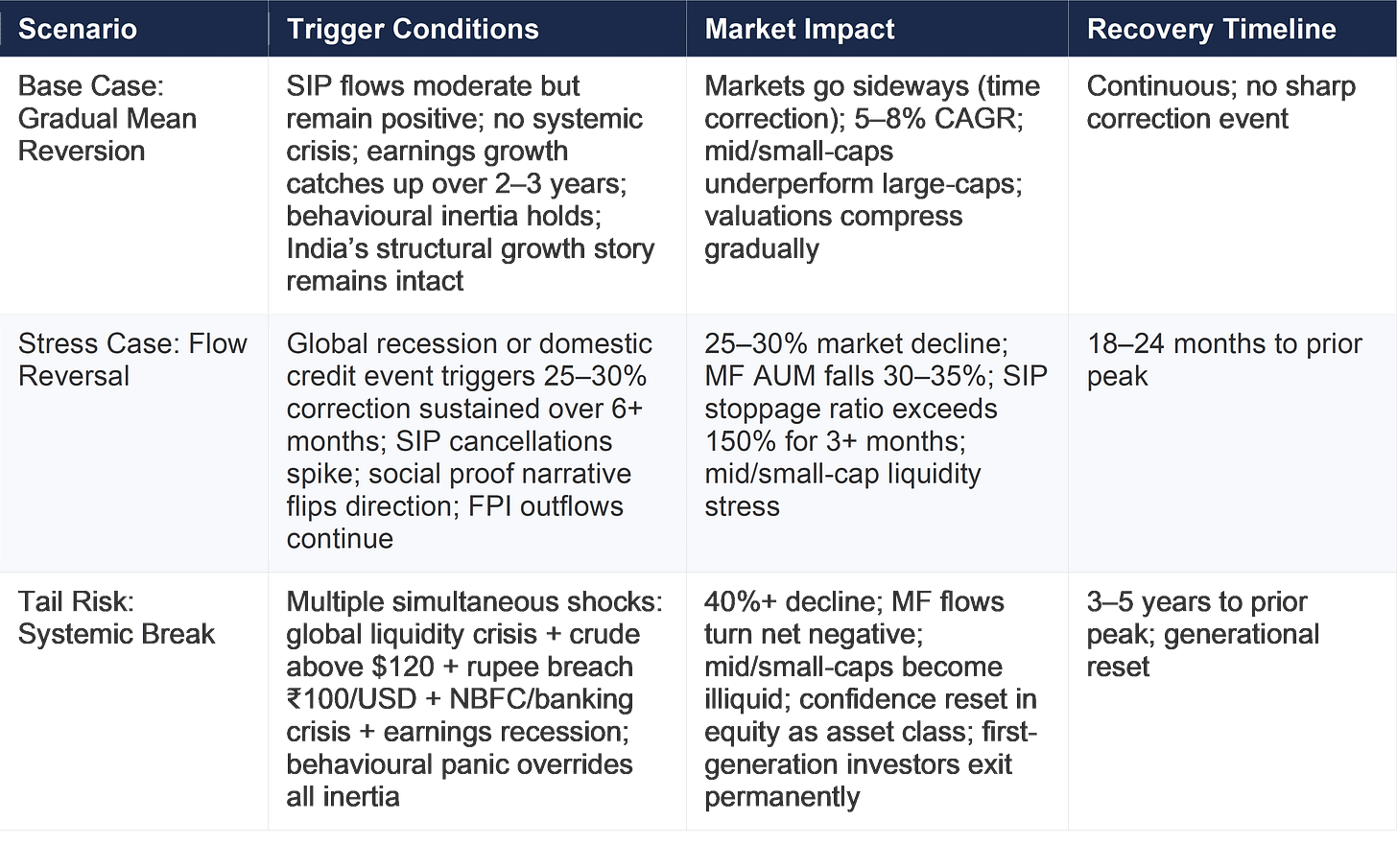
Probability assessment: The base case remains the most likely outcome (estimated 55–65% probability). India’s fundamental growth story, the depth of the domestic savings pool, and the sheer scale of monthly SIP flows provide genuine structural support. The stress case (25–30% probability) requires a specific catalyst but the list of potential triggers — global recession, domestic credit event, sustained crude shock — is not fanciful. The tail risk scenario (5–15% probability) requires a convergence of multiple adverse factors but is not unprecedented in global market history.
8. What Could Break the Behavioural Lock-In
8.1 The Emergence of a Competing Ecosystem
If a competing product achieves the same combination of zero-friction automation, compelling narrative, distribution reach, and social proof as the equity SIP — but channels flows into a different asset class — it could divert incremental savings. A gold SIP product at scale with equivalent fintech integration, a multi-asset auto-rebalancing SIP, or a real estate fractional ownership platform with SIP-like mechanics could gradually erode the equity SIP’s monopoly on automated household savings. The critical variable is not product availability (gold SIPs already exist) but ecosystem completeness: marketing spend, platform prominence, distributor incentives, and social proof.
8.2 A Narrative Reversal via Social Media
The pro-SIP narrative is sustained by advertising and reinforced by positive returns. A prolonged period where SIP returns visibly underperform fixed deposits or gold, a high-profile AMC failure, or a SEBI enforcement action could trigger a counter-narrative that spreads virally through the same social media channels that currently amplify the pro-SIP message. In an environment where financial influencers have massive reach among first-generation investors, a narrative reversal could propagate faster than in any previous market cycle.
8.3 A Generational First-Loss Experience
Most current SIP investors entered post-2020 and have never experienced a genuine prolonged bear market. Their behavioural conditioning is entirely one-directional. Behavioural research on first-time loss experiences shows they create disproportionately strong negative impressions that permanently alter future risk behaviour — the “once bitten, twice shy” effect formally documented in prospect theory. A generation that experiences its first 30%+ drawdown sustained over 12+ months may never return to the same level of automatic equity participation.
8.4 Regulatory Re-Engineering of Defaults
If SEBI were to mandate periodic investor re-confirmation (such as an annual active opt-in rather than passive continuation), it would introduce decision friction into a system that currently has none. This would force millions of investors who continue their SIPs purely through inertia to make an active choice, dramatically increasing the rate of reassessment and potentially reallocation. Similarly, mandatory multi-asset allocation defaults for new SIPs (mirroring the US target-date fund approach) could structurally diversify flows away from pure equity.
9. Strategic Implications for Stakeholders
9.1 For Corporate Decision-Makers
Companies that have relied on elevated equity valuations for capital raising, acquisition currency, or ESOP-based compensation should stress-test their financial plans against the stress and tail-risk scenarios. The window for equity fundraising at favourable valuations may be narrower than current conditions suggest. Corporate treasury teams should assess counterparty exposure to highly-leveraged market participants and ensure adequate liquidity buffers.
9.2 For Institutional Allocators
The current environment rewards a barbell allocation: maintain core equity exposure to benefit from India’s genuine secular growth story, but hedge tail risk through reduced mid/small-cap allocation, increased cash buffers, and explicit downside protection. The asymmetry — where upside is constrained by rich valuations but downside could be amplified by a redemption-driven feedback loop — favours capital preservation over return maximisation at the margin.
9.3 For Policy Advisors and Regulators
The structural dependence on SIP flows represents a concentration risk at the systemic level. Regulators should consider: mandatory liquidity stress testing for equity mutual funds, redemption-specific circuit-breaker mechanisms, enhanced portfolio liquidity disclosure, investor education that honestly addresses the possibility of extended bear markets and the limitations of “time in the market” as a universal principle, and product design requirements that encourage multi-asset diversification within SIP structures.
9.4 For the Mutual Fund Industry
The industry faces a long-term reputational risk if the current cycle ends in a manner that causes widespread retail losses. The one-directional framing that has been effective in attracting flows will be re-examined harshly if a generation of SIP investors experiences deep, sustained losses. The industry would be well-served by proactively promoting diversified asset allocation (including gold, debt, and real assets alongside equity), introducing built-in rebalancing mechanisms within SIP products, and reducing the emphasis on pure equity narratives. A generation of investors who trust mutual funds because of a balanced, honest experience will provide more durable AUM growth than one that feels it received incomplete information.
10. Conclusion: The Machine Doesn’t Eliminate Risk — It Transforms It
The SIP-driven mutual fund machine has been an extraordinary force for financial inclusion, wealth creation, and market stability. It has delivered genuine value to millions of Indian households through disciplined dollar-cost averaging. It has transformed India’s capital market structure, reduced dependence on volatile foreign flows, and enabled a generation of first-time savers to participate in the country’s growth story. These are important achievements that deserve acknowledgement.
However, the mechanism does not eliminate the fundamental risks inherent in equity investing. It transforms and redistributes them. The dollar-cost averaging that builds wealth during volatile markets with an upward drift can accumulate losses during a prolonged structural bear market. The behavioural inertia that prevents destructive panic selling during normal corrections can delay necessary portfolio adjustments when conditions change materially. The one-directional framing that attracts flows into equities can create a generation of investors who are unprepared for the reality that equities can deliver negative real returns over extended periods.
The tipping point, when it comes, will not be a single event. It will be a convergence of conditions — some combination of earnings disappointment, external shocks, currency pressure, and a narrative reversal that penetrates social media — that collectively overwhelm the behavioural inertia and the inflow mechanism. The historical precedents, applied with appropriate caveats, suggest that markets sustained significantly by flows rather than fundamentals eventually experience a repricing, and the magnitude of that repricing correlates with the duration and scale of the preceding flow-driven divergence.
The strategic imperative for every stakeholder — corporate boards, institutional allocators, regulators, and the mutual fund industry itself — is not to predict timing, which is inherently impossible, but to ensure that plans and frameworks are resilient enough to absorb the full range of outcomes. India’s growth story is real. The SIP mechanism is sound in principle. But a sound mechanism operating at unsound valuations, sustained by behavioural inertia as much as by fundamental conviction, carries risks that are best addressed before they materialise.
The mechanical bull runs until it doesn’t — and the riders who survive are those who planned for the dismount.
DISCLAIMER
This document is prepared by Blue Mango Consulting Group for informational and strategic planning purposes only. It does not constitute investment advice, a solicitation to buy or sell securities, or a recommendation regarding any specific financial product. All data cited is sourced from AMFI, SEBI, ICRA Analytics, NSE, NSDL, SBI Research, CFA Institute, and publicly available market reports. The economic and investment principles referenced include works by Samuelson & Zeckhauser (status-quo bias), Thaler & Sunstein (nudge theory and defaults), Shiller (narrative economics), and Kahneman & Tversky (prospect theory). Mutual fund investments are subject to market risks. Past performance and historical precedents do not guarantee future outcomes. Readers are advised to consult qualified financial advisors before making investment decisions.