

India's Gold Market is undergoing Structural Transformation
STRATEGIC DEEP DIVE & CONSULTATIVE ADVISORY
INDIA GOLD MARKET
Navigating the ₹1.5 Lakh Era: From Macro Shifts to Segment-Specific Strategy
For Retailers • Wholesalers • Manufacturers
April 2026 | bluemangoconsultinggroup.com
Confidential — For Client Distribution Only
Table of Contents
PART A: STRATEGIC DEEP DIVE — THE MARKET LANDSCAPE
-
Executive Summary
-
The Price Surge Paradox: Volumes Down, Values Up
-
Global Macro Forces Driving the Rally
-
India’s Domestic Amplifiers: RBI, Duty Cuts, and Policy
-
The Great Migration: From Jewellery to Investment
-
Stakeholder Impact Analysis Across the Value Chain
-
Emerging Business Models and the Grey Market
-
Regulation and Policy Landscape
-
Global Parallels: China, Middle East, and Western Markets
-
Silver, Lab-Grown Diamonds, and Alternatives
-
The Wedding Economy Under Price Pressure
-
The Big Risk: Erosion of Gold Savings Culture
-
Crime, Recycling, Rural-Urban Divide, and Forex Impact
PART B: CONSULTATIVE ADVISORY — SEGMENT GUIDELINES
-
Strategic Advisory for Gold Retailers
-
Strategic Advisory for Gold Wholesalers
-
Strategic Advisory for Gold Manufacturers
-
The Five Forces Reshaping India’s Gold Ecosystem Through 2030
-
Conclusion and BMCG’s Call to Action
PART A
STRATEGIC DEEP DIVE — THE MARKET LANDSCAPE
1. Executive Summary
India’s gold ecosystem is pivoting from a consumption-led, jewellery-dominated market toward a financialized, investment-driven asset class — and the consequences ripple across every layer of the economy.
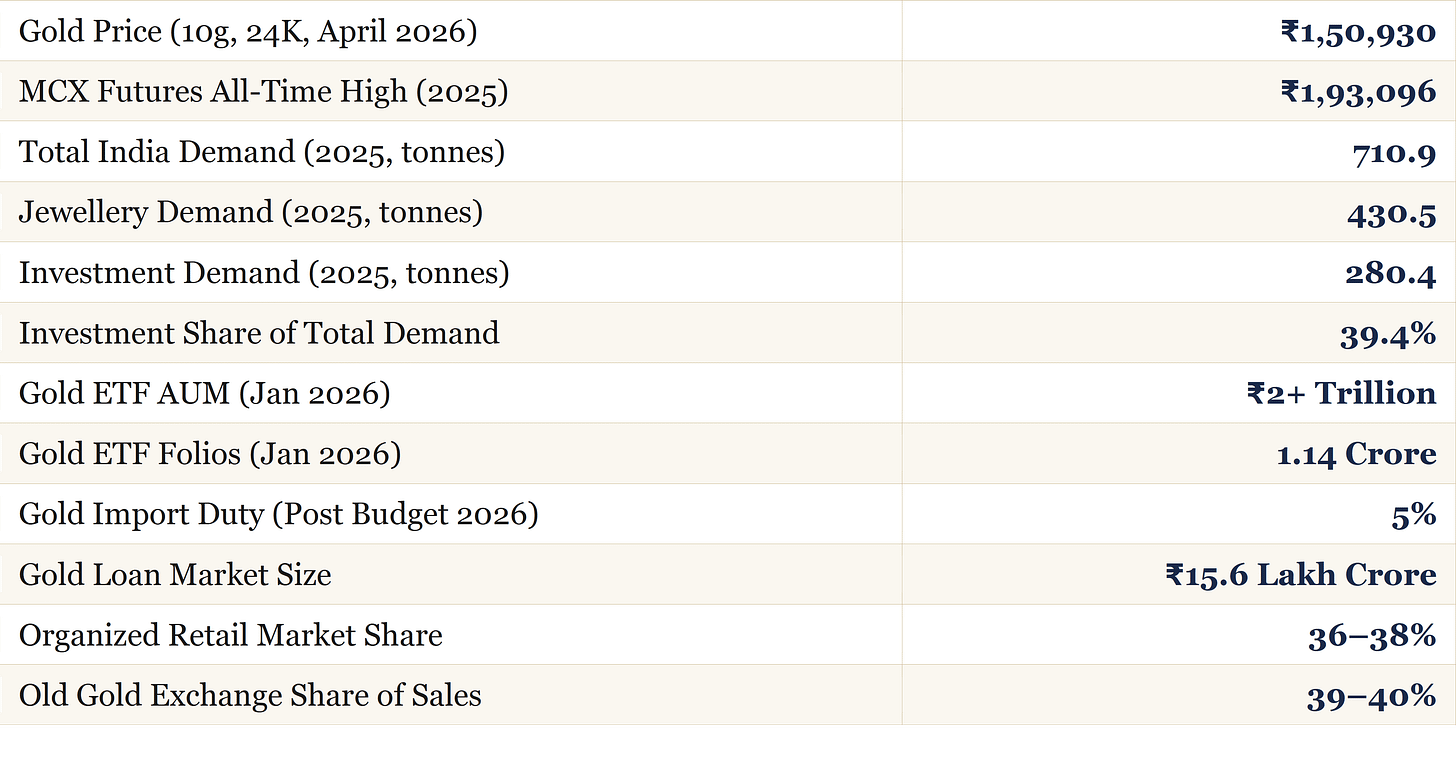
In 2025, investment gold’s share of total demand nearly doubled to 39.4% from 22% just three years earlier, while jewellery volumes plunged 24% to their lowest level in recent history. This is not a cyclical blip. The convergence of record prices (gold crossed ₹1.5 lakh/10g by early 2026), regulatory overhauls (import duty slashed to 5%, Sovereign Gold Bonds discontinued), explosive ETF growth (AUM up 187% in a single year), and generational behavioural shifts is permanently reshaping a $90-billion industry that touches 1.4 billion lives.
For businesses operating in or adjacent to this ecosystem — whether you are a family jeweller in Rajkot, a bullion trader in Zaveri Bazaar, or a manufacturer in Thrissur — the strategic imperative is unambiguous: the gold market you planned for no longer exists.
2. The Price Surge Paradox: Volumes Down, Values Up
The headline numbers tell a deceptive story. India’s total gold demand fell 11% in volume to 710.9 tonnes in 2025 — yet in value terms, it surged 30% to ₹7,51,490 crore. This paradox is the defining dynamic of the current era. Gold prices delivered a staggering 75% return in INR during 2025 alone, crossing ₹1 lakh/10g for the first time and breaching ₹1.3 lakh by December. International prices surpassed $3,500/oz and are tracking toward $5,000/oz by Q4 2026 according to J.P. Morgan consensus.
At the retail level, the implications are immediate. A standard bridal gold set of approximately 100 grams that cost ₹6.3 lakh in early 2024 now costs over ₹14 lakh — more than the annual household income of a median Indian family. A 2-gram gold chain that yielded ₹9,600 to a thief in 2020 now fetches ₹25,000 — a 160% increase in criminal reward for identical risk. These are not abstract numbers; they reshape consumer behaviour, business viability, and social equilibrium simultaneously.
Key Market Indicators (2025–2026)
3. Global Macro Forces Driving the Rally
Three forces are driving this rally simultaneously. First, global central banks purchased over 1,000 tonnes annually for three consecutive years (2022–2024), with Poland alone buying 102 tonnes in 2025. The US freezing of Russia’s $300 billion in dollar reserves post-Ukraine triggered a de-dollarization imperative that continues to accelerate gold accumulation. Second, the Fed’s rate-cutting cycle from 2024 onward reduced the opportunity cost of holding gold, unleashing Western ETF inflows that reached record levels — $18.7 billion in January 2026 alone. Third, persistent geopolitical tensions across Ukraine, the Middle East, and US-China trade created a sustained risk premium.
The RBI has been one of the world’s most active central bank gold buyers. It purchased 72.6 tonnes in 2024, pushing gold’s share of forex reserves from 10% to 15.6% — largely through price appreciation of its 880-tonne hoard now worth over $108 billion. This institutional demand creates a structural price floor that did not exist a decade ago.
4. India’s Domestic Amplifiers: RBI, Duty Cuts, and Policy
The July 2024 import duty slash from 15% to 6% — the sharpest cut on record — initially sparked a 221% surge in August 2024 imports and shifted domestic prices from a record $110/oz discount to a premium overnight. The Budget 2026 further reduced the effective duty to 5% (4% BCD + 1% AIDC), continuing the formalization trajectory.
The Sovereign Gold Bond scheme has been effectively discontinued after the government acknowledged it became “high-cost borrowing” — early series delivered 120–320% returns at maturity. This vacuum is now being filled by ETFs and digital gold. SEBI’s April 2026 mandate shifting gold ETF valuation from LBMA benchmarks to domestic spot prices mirrors China’s Shanghai Gold Fix model, signalling India’s intent to become a price-setter rather than a price-taker.
The RBI’s new Gold Lending Directions 2025, effective April 1, 2026, introduce a tiered LTV framework (85% for loans up to ₹2.5 lakh, 80% for ₹2.5–5 lakh, 75% above ₹5 lakh). BIS mandatory hallmarking now covers 9K gold (from July 2025) and silver HUID (from September 2025), with over 44.28 crore gold items hallmarked cumulatively across 361 districts.
5. The Great Migration: From Jewellery to Investment
The most consequential shift in India’s gold market is the migration from jewellery consumption to investment instruments. Jewellery demand collapsed from 563.4 tonnes (2024) to 430.5 tonnes (2025) — a 24% decline representing the steepest annual drop in recent history. Meanwhile, bar-and-coin investment climbed to approximately 280 tonnes, and gold ETF folios exploded from 7.83 lakh (2020) to 1.14 crore (January 2026) — a 15x increase in five years.
Gold ETFs crossed a watershed in January 2026 when their monthly inflows (₹24,039 crore) exceeded equity mutual fund inflows (₹24,029 crore) for the first time ever.
Digital gold purchases via UPI nearly doubled from approximately 8 tonnes (2024) to 13.5 tonnes (2025), with monthly transaction values tripling from ₹800 crore to ₹2,200 crore. Apps like Jar (35 million+ registered users, 95% saving formally for the first time) are democratizing gold investment to mobile-first demographics in Tier-2 and Tier-3 towns. Among consumers under 35, 75% prefer digital gold over physical purchases.
The strategic question is no longer whether India is financializing gold, but how fast. If investment demand’s share continues rising at the current trajectory (from 22% in 2022 to 39% in 2025), it could surpass jewellery demand by 2027–2028. This would be a civilizational-scale shift for a culture where gold jewellery has been the default store of value for millennia.
6. Stakeholder Impact Analysis Across the Value Chain
Consumers
Consumer behaviour has bifurcated sharply. Wedding purchases remain culturally non-negotiable but are being executed differently: 40–45% of jewellery purchases now involve old-gold exchange (up from ~20% pre-2023), brides work within “gram budgets” to maximize design value over weight, and detachable/convertible jewellery is gaining popularity. Investment-oriented consumers have migrated to ETFs, digital gold, coins, and bars. A February 2026 survey found that 62% of Gen Z and millennials still consider gold the safest investment, but 42.3% now make self-initiated purchases rather than parent-led buying.
Organized Retailers vs. Local Jewellers
Organized retailers are the clear winners. Tanishq posted jewellery revenue of ₹46,571 crore in FY25 (21% growth), operating 1,091 stores and capturing approximately 8–8.6% market share. Kalyan Jewellers hit ₹25,050 crore revenue (33%+ growth) with 469 showrooms. The organized sector’s share has surged from 22% in FY19 to 36–38% today, projected to reach 60% by 2029.
Local family jewellers face existential pressure but retain decisive advantages: personalized relationships built over generations, negotiable making charges, regional design expertise, and lower overhead. Their survival depends on adapting through hallmarking compliance, old gold exchange programs, and digital presence rather than competing on scale.
Wholesalers and Bullion Traders
Wholesalers face heightened volatility-led inventory risk. When gold swings multiple percentage points in a single session, replacement risk can erase margins on multi-crore transactions. The expanding gold loan market (₹15.6 lakh crore, up 42% YoY) creates both opportunity (as collateral values rise) and risk (if prices correct sharply). PMLA compliance obligations for cash transactions above ₹10 lakh add operational complexity.
Manufacturers
Demand unpredictability is the core challenge: Q3 2025 jewellery demand fell 31% year-on-year to 117.7 tonnes, while 50–55% of annual consumption concentrates in wedding and festival seasons. The shift toward lightweight, lower-carat jewellery fundamentally changes production requirements, favouring manufacturers with electroforming, CAD/CAM, and 3D printing capabilities. The karigar workforce crisis — aging artisans, post-COVID exodus, 81% talent shortage — is the most underestimated strategic risk.
7. Emerging Business Models and the Grey Market
Formal and Scalable Models
The most consequential innovation is the convergence of digital gold, gold leasing, and organized exchange programs into an integrated “gold-as-a-service” ecosystem. SafeGold processed ₹6,867 crore in transactions in FY25 and turned EBITDA positive. Gullak’s Gold+ product pioneered gold leasing — users earn 5% additional gold annually by lending digital holdings to jewellers as working capital. Tanishq has processed 170 tonnes of old gold through its exchange program, serving over 2 million customers.
Subscription gold savings models (Tanishq’s Golden Harvest, Jar’s daily SIPs starting from ₹10) are creating recurring revenue infrastructure that mirrors the SIP revolution in mutual funds. Gold loan companies — Muthoot Finance (₹1.47 lakh crore AUM, 51% YoY growth), Manappuram, and IIFL — represent perhaps the largest adjacent opportunity, with $3.8 trillion in household gold and only a fraction monetized.
Grey Market and Smuggling
Despite the duty cut, the subsequent 67% price surge in 2025 pushed smuggling margins back up to ₹1.15 million/kg, restoring incentives entirely. Authorities registered 3,005 smuggling cases and seized 2.6 tonnes in FY25, but actual volumes are estimated at 100–155 tonnes annually. Modern smuggling networks now use cryptocurrency for settlement, with one 108-kg transnational racket routing $12.7 million through USDT. The government’s structural dilemma persists: lower duties reduce smuggling but amplify the current account deficit (gold contributes over 5% of total imports).
8. Regulation and Policy Landscape
The policy environment has shifted decisively toward formalization. Import duty reductions (15% → 6% → 5% in two years), mandatory BIS hallmarking expansion (now covering 9K gold and silver), PMLA reporting obligations for precious metal dealers, and the PAN requirement for purchases above ₹2 lakh collectively compress the operating space for unorganized players. The discontinuation of Sovereign Gold Bonds redirects investor demand toward ETFs and digital gold.
However, BMCG flags a significant policy reversal risk: with gold imports hitting $58.9 billion in calendar year 2025 and pressuring the current account deficit, speculation persists about a potential duty increase. Any reversal would temporarily widen smuggling arbitrage while disrupting legitimate supply chains. Businesses must build regulatory optionality into their strategies, not treat the current 5% duty as permanent.
Digital gold remains unregulated despite SEBI’s November 2025 warning to investors. The absence of a regulatory framework creates both opportunity (rapid growth without compliance burden) and risk (potential regulatory disruption). BMCG expects formal regulation by 2027, likely bringing digital gold under SEBI or RBI oversight.
9. Global Parallels: China, Middle East, and Western Markets
China offers the closest comparison, with its gold market also shifting from jewellery to investment. Chinese jewellery demand fell to the lowest H1 since 2009, while bar-and-coin investment hit an 11-year high. The “gold bean” phenomenon — 1-gram gold pieces marketed to Gen Z — has no direct Indian parallel, though India’s digital gold micro-investments serve a similar democratization function.
The Middle East shows gold jewellery in secular decline (per capita consumption in UAE fell from 9.1g in 2011 to 4.4g in 2024), while Western markets are overwhelmingly ETF-driven. India is charting a unique hybrid path: simultaneously maintaining cultural gold consumption (in lighter, lower-carat forms), building investment infrastructure (ETFs, digital gold), and monetizing existing holdings (gold loans, exchange programs). No other market is attempting this three-pronged transition simultaneously.
India’s $3.8 trillion private gold hoard (25,000–35,000 tonnes, representing 11–14% of all gold ever mined) dwarfs any other nation’s household holdings. The gold loan ecosystem, where 2,950–3,350 tonnes serve as collateral, is uniquely Indian and represents a form of financialization absent in China or the West.
10. Silver, Lab-Grown Diamonds, and Alternatives
India became the world’s largest importer of refined silver in 2025, with imports surging 44% to $9.2 billion. Silver is benefiting from dual demand: substitutionary (consumers priced out of gold choosing silver for jewellery and gifts) and investment-driven (industrial demand from solar panels, silver ETF inflows tripling).
Lab-grown diamonds represent a slow but irreversible disruption. India’s LGD jewellery market reached approximately $400 million in FY25, with over 70% of millennials now buying lab-grown diamond rings. At 60–85% cheaper than natural diamonds, LGDs allow couples to choose larger stones at a fraction of the price. India is the world’s largest LGD exporter (28.6% global share) and produces roughly 35% of global supply.
Platinum jewellery demand leapt 31% in India in 2024 — the largest growth of any country globally. At 60–65% cheaper than gold, platinum is positioning as the “affordable luxury” alternative. The artificial jewellery market (approximately ₹8,000 crore, 11.4% CAGR) is also benefiting, with premium imitation pieces now accounting for 47% of market value.
11. The Wedding Economy Under Price Pressure
India’s $130-billion wedding industry, where gold jewellery accounts for 50–55% of revenue, is being reshaped by price reality. At current prices, a basic bridal gold set (~100g) costs approximately ₹14–15 lakh — roughly 1.5–2x the annual household income for middle-class families.
The response is not rejection of gold but adaptation: families delay purchases to auspicious price dips, exchange old gold aggressively (40–45% of purchases), choose lighter designs, and redirect savings toward experiences (1 in 4 weddings in 2025 were destination weddings). Regional variations remain stark: South Indian weddings traditionally require 100–200g sets and remain the most gold-intensive, while North Indian brides increasingly choose diamond, Kundan, and fusion jewellery.
Second-order consequences extend beyond jewellery. If gold’s role in weddings diminishes, the cascading impact touches local jewellers (most vulnerable to margin compression), gold loan companies (whose collateral base could shift), wedding planners (redirecting budgets toward experiences), and the broader cultural economy of social signalling.
12. The Big Risk: Erosion of Gold Savings Culture
Gold’s role as India’s default savings instrument extends far beyond investment returns. For households earning below ₹1.79 lakh, gold constitutes 24% of total wealth — it serves as inflation hedge, emergency liquidity, and intergenerational wealth transfer simultaneously. During COVID-19, households in high-impact districts shifted portfolios toward gold and away from financial assets, validating its crisis-response function.
A weakening of gold savings culture would expose financially vulnerable populations to greater dependence on formal finance systems that many still cannot fully access. While financial inclusion has expanded dramatically (SIP accounts reached 92.5 million, equity’s share of household savings jumped from 4% to 15.1%), rural India — which accounts for 60% of gold demand — remains underserved by formal financial products.
Encouragingly, younger Indians are not abandoning gold but redefining their relationship with it. 62% of Gen Z and millennials still consider gold the safest investment, but the mode of engagement is shifting: purchases are increasingly self-initiated, average purchase size is shrinking (27.5% buy under 2 grams), and digital formats are preferred. Gold is becoming more of a financial asset and less of a cultural artifact.
13. Crime, Recycling, Rural-Urban Divide, and Forex Impact
Crime Linkages
The correlation between gold prices and gold-related crime is direct and measurable. Hyderabad alone recorded 139 gold-related crimes in 2025 (nearly one every two days). Modern criminals use WhatsApp for coordination, YouTube for techniques, and convert stolen gold into cryptocurrency. As metro cities tighten security, crime is migrating to Tier-2 and Tier-3 cities.
Recycling Economy
India recycled approximately 114 tonnes of gold in 2024, ranking fourth globally with refining capacity of 1,800 tonnes. Old-gold exchange now accounts for 39–40% of all jewellery sales. India has 33 BIS-licensed refineries, though capacity utilization varies widely. This “circular gold economy” partially insulates demand from import dependency.
Rural vs. Urban Divergence
India effectively operates two parallel gold markets. Rural areas (60% of demand) remain overwhelmingly physical-jewellery-oriented, price-sensitive to monsoon quality, and served primarily by local jewellers. Urban consumers are rapidly adopting ETFs, digital gold, and lighter/lower-carat designs. Digital gold penetration stands at 11% in metros but negligibly lower in rural areas.
Forex and Current Account Impact
Gold imports consumed $58.9 billion in calendar 2025, representing over 5% of total imports and periodically spiking the trade deficit (October 2025’s record $14.7 billion single-month gold import drove the merchandise trade deficit to an all-time $41.7 billion). This structural dependency constrains policy flexibility and creates a permanent tension between enabling legal demand and managing macroeconomic stability.
PART B
CONSULTATIVE ADVISORY — SEGMENT GUIDELINES
14. Strategic Advisory for Gold Retailers
BMCG’s Core Thesis for Retailers: Transform from gold-weight sellers into design-led, digitally enabled, compliance-differentiated experience providers who leverage old gold exchange as their primary customer acquisition engine.
14.1 Inventory Management: The New Calculus
A jeweller who held 5 kilograms of gold inventory three years ago at ₹30 crore now needs ₹75 crore for the same quantity. Gross margins on plain gold remain at 10–14%, while diamond-studded pieces yield 30–35%. BMCG recommends three actions:
Gold-on-lease as default procurement: Banks offer lease rates of 3.5–4% annually versus 12–13% for corporate loans. SafeGold is pioneering a model where digital gold holders lease metal to small jewellers. This eliminates price exposure during the selling cycle.
MCX hedging for residual exposure: The new Gold Ten contract (10g, launched April 2025) is specifically designed for retail-scale hedging with compulsory physical delivery. Thangamayil Jewellery hedges 89% of its inventory on MCX — a benchmark that all retailers should aspire toward.
Accelerate inventory velocity: Data-led assortment planning, smaller batch procurement, and deliberate shift toward designs with faster turnover cycles. At ₹1.5 lakh gold, every day of unsold inventory represents significant capital cost.
14.2 Competing with Tanishq and Kalyan: The Local Jeweller’s Playbook
The competitive threat from organized chains is real but not insurmountable. Tanishq operates over 505 stores; Kalyan added 76 showrooms in FY25 with 170 more planned. Yet local jewellers retain decisive advantages:
Design-led pricing: Making charges for handcrafted pieces command 20–30% versus 5–10% for machine-made items. Intricate regional specialties (temple jewellery, jadau, meenakari) cannot be replicated at scale by chains. Move from weight-based selling to design-as-value-proposition.
Old gold exchange as acquisition engine: Senco Gold derives 40% of sales from exchanges. Build programs that offer transparent purity testing (invest in karatmeters), full market value on hallmarked gold, and competitive making charges on new purchases.
Digital presence: Not necessarily e-commerce, but CRM-integrated WhatsApp strategy, Google Business optimization, appointment booking, and AR try-on tools available as white-label solutions. CaratLane’s app draws 10 million monthly users and generates over ₹3,000 crore in annual revenue, with 80% of in-store visits driven by digital touchpoints.
14.3 BIS Hallmarking as Competitive Weapon
With over 700 cases of fraudulent hallmarking uncovered in 2025, hallmarking compliance is table stakes. But proactive jewellers can turn it into a marketing advantage. Prominently display BIS certification, train staff to demonstrate the BIS CARE App verification process, and use hallmarking as a trust signal in all marketing. The expansion to 9K gold and silver HUID creates new product categories that compliant jewellers can exploit first.
14.4 Countering the ETF and Digital Gold Migration
Gold ETFs attracted record inflows of ₹31,300 crore in the first 11 months of 2025. Physical retailers must reposition around what digital products cannot offer: emotional value, cultural significance, and the experience of wearing.
Launch gold savings schemes that lock customers into future physical purchases while offering systematic investment appeal. Develop hybrid offerings — partnerships with digital gold platforms that allow customers to accumulate digital gold and convert to jewellery at your store. Lean into lightweight and lower-carat products — 14K, 18K, and the new 9K hallmarking category create affordable entry points.
14.5 Wedding Season Planning at ₹1.5 Lakh Gold
India’s wedding economy generates approximately ₹6.5 lakh crore annually. A standard 200-gram bridal trousseau now exceeds ₹20 lakh. Build inventory 2–3 months ahead of peak windows using gold-on-lease. Shift assortments toward lighter, design-forward bridal sets. Integrate lab-grown diamonds for cocktail and reception wear. Capture advance demand through 10–11-month gold savings schemes. South India favours temple and plain gold styles; North India emphasizes kundan, polki, and jadau — regional customization is non-negotiable.
15. Strategic Advisory for Gold Wholesalers
BMCG’s Core Thesis for Wholesalers: Evolve from commodity intermediaries into value-added supply chain partners who combine IIBX-enabled direct imports, certified traceability, and digital platform capabilities with institutional-grade compliance infrastructure.
15.1 Inventory Risk Management in a Volatile Market
Wholesalers are structurally short volatility. The standard toolkit includes back-to-back trading, MCX hedging, and Gold Metal Loans. BMCG recommends formalizing a hedge policy with a target coverage ratio of 80–90% on MCX. The main Gold contract (1 kg lot, margin ~₹4.5–9 lakh), Gold Mini (100g, ~₹15,000 margin), and Gold Ten (10g) serve different position sizes. Weekly contracts allow delivery every week rather than waiting for monthly expiry. Accept basis risk rather than leaving positions unhedged.
15.2 Import Duty Arbitrage and the Grey Market Challenge
The effective 5% duty plus 3% GST creates an approximately 9% total tax burden on imported gold, funding grey market incentives with smuggling profits at ~₹1.15 million per kilogram. The India-UAE CEPA tariff rate quota (180 metric tonnes for FY25-26) creates a preferential channel. Establish Qualified Jeweller status for IIBX access (minimum ₹15 crore net worth, 60% of turnover from jewellery activities). Direct IIBX imports bypass traditional bank intermediary fees of approximately $2 per ounce.
15.3 The RBI’s Expanded Gold Metal Loan Framework
The April 2026 RBI overhaul is transformative: non-manufacturing jewellers can now access Gold Metal Loans for the first time, expanding the addressable market dramatically. Two categories exist — import-linked GMLs (repayment in cash only) and GMS-linked GMLs (repayment in gold, cash, or combination) — with a maximum 270-day tenor. This creates the opportunity for wholesalers to serve as intermediaries, feeding gold into a vastly expanded pool of GML-eligible jewellers.
15.4 PMLA Compliance as Survival Infrastructure
The PMLA framework designates dealers in precious metals with cash transactions of ₹10 lakh or above as Reporting Entities, triggering KYC/CDD obligations, Central KYC Registry integration, Enhanced Due Diligence for PEP-related transactions, Suspicious Transaction Reports within 7 working days, and Cash Transaction Reports above threshold. BMCG recommends appointing dedicated compliance officers, implementing automated transaction monitoring, and positioning compliance credentials as a selling point when building relationships with organized retail chains.
15.5 IIBX and Digital Platforms: The Next Competitive Frontier
IIBX offers T+0 settlement with multiple daily cycles, 100g and 1kg purchase flexibility, and 24-hour nationwide delivery. Its recognition has been renewed through December 2028. The proposed Good Delivery Guidelines 2025 will broaden acceptable refiners.
On the digital front, no dominant B2B bullion marketplace exists yet — platforms like Augmont (4 crore+ users) and All India Bullion (400,000+ users) are emerging. BMCG identifies this as a significant first-mover opportunity: wholesalers who build or partner with digital B2B platforms offering transparent pricing, quality-certified products, and integrated logistics can capture the formalization wave.
15.6 Supply Chain Traceability
Organized retailers increasingly demand LBMA-certified, responsibly sourced gold. The LBMA’s Responsible Gold Guidance v10, launching 2025-26, requires refiners to disclose supplier identities. From January 2026, LBMA requires public disclosure of all mines supplying Good Delivery List refiners. Source from LBMA or India Good Delivery accredited refiners, implement chain-of-custody documentation, and consider blockchain-based provenance tracking.
16. Strategic Advisory for Gold Manufacturers
BMCG’s Core Thesis for Manufacturers: Navigate the twin challenges of workforce transformation and technology adoption while rebalancing production toward lightweight designs, diversified export markets, and lab-grown diamond integration.
16.1 Production Planning Under Demand Unpredictability
Large organized manufacturers manage volatility through a flexible capacity model: 60–70% outsourced (mostly handmade) and 30–40% in-house (primarily machine-made). This dual structure allows rapid scaling during peaks while avoiding fixed-cost overload during troughs. The fundamental planning principle at ₹1.5 lakh gold is to never build speculative inventory: produce to order or to confirmed commitments, using gold-on-lease to eliminate raw material price risk.
BMCG recommends investing in AI-driven demand-sensing tools integrated with ERP systems that track real-time order patterns, seasonal indicators, and price-sensitivity thresholds. The World Gold Council forecasts 2026 demand at 600–700 tonnes — planning must accommodate this structural volume decline.
16.2 Export Market Diversification
Gold jewellery exports reached $10.71 billion in April 2025–February 2026, growing 5.99% YoY. UAE exports surged 22% to $8.41 billion (plain gold jewellery to UAE up 61% in H1), while US exports collapsed 44% to $4.65 billion due to tariffs. The UK emerged as a bright spot after the India-UK CETA eliminated 2.5–4% import duties. Saudi Arabia recorded 124% growth.
Manufacturers must recalibrate production for these shifting destinations. UAE: 22K gold in traditional and modern Middle Eastern designs. UK/EU: 18K and 14K with contemporary Western aesthetics and lab-grown diamond integration. GJEPC’s long-term vision targets $100 billion in exports by 2047. Pursue RJC certification and align with LBMA responsible sourcing standards — increasingly non-negotiable for Western buyers.
16.3 The Karigar Crisis: The Industry’s Underestimated Risk
Approximately 70,000–80,000 karigars work in and around Mumbai’s Zaveri Bazaar alone, with average age 35.5 years and specializations so narrow that a single jewellery item may pass through 4+ specialist artisans. An estimated 81% talent shortage exists in India’s consumer goods sector.
BMCG recommends three interventions: Establish in-house training programs aligned with the Gem & Jewellery Skill Council’s NSQF framework, leveraging PM Vishwakarma incentives. Improve working conditions and formalize employment with health insurance and documented relationships. Develop a hybrid workforce model where skilled karigars focus on premium/complex pieces while machine operators handle high-volume production. Key clusters: Zaveri Bazaar (Mumbai), Rajkot (Gujarat), Kolkata, Jaipur, and Thrissur.
16.4 CAD/CAM, 3D Printing, and Electroforming: The Technology Imperative
CAD software (Rhino, MatrixGold, JewelCAD) is now standard for design across organized players. DLP LED-based 3D printers from Indian manufacturers like Sculptoris Innovation (Surat) start at approximately ₹2 lakh. Direct metal printing via SLS is emerging for producing gold pieces without traditional casting.
Electroforming is the pivotal technology for lightweight jewellery: pieces of 2–3 grams match the visual impact of pieces requiring double the material. Turnkey plants available from Delmer Group (Baroda) and MAK Gold Electrotech produce 8K to 22K hollow products. Chinese “Hard Pure Gold” (999.9 purity, Vickers hardness 60+ HV) is already entering India — Indian manufacturers must respond with equivalent technology investment.
BMCG’s investment thresholds by scale: Entry-level (artisan workshops): DLP printers + basic CAD, ₹5–10 lakh. Mid-sized: CNC + electroforming capability, ₹50 lakh–₹2 crore. Large-scale: Fully automated lines with robotic stone-setting and laser finishing. Leading Indian technology providers: HK Malvi Industries (Rajkot), Sculptoris Innovation (Surat), Delmer Group (Baroda), JewelCare India (Ahmedabad).
16.5 Raw Material Strategy: Gold-on-Lease + Recycled Gold
Gold-on-lease at 3.5–4% interest eliminates price exposure during manufacturing and dramatically reduces working capital versus outright purchase at 8–12% loan rates. The new RBI framework (April 2026) expands access, but manufacturers retain structural advantage through established banking relationships.
Recycled gold is the second strategic pillar. India ranks fourth globally in gold recycling with refining capacity of 1,800 tonnes. MMTC-PAMP has deployed Purity Verification Centres with German XRF machines nationwide. For export-oriented manufacturers, SGS-certified recycled gold with RJC Chain of Custody certification is increasingly required. Build direct recycled gold sourcing relationships to reduce import dependency and create a sustainability narrative.
16.6 Lab-Grown Diamond Integration
India’s LGD jewellery market is estimated at $300–350 million (15% CAGR), with India being the world’s largest LGD exporter (28.6% global share). LGDs priced 60–80% below natural diamonds make diamond-studded gold jewellery accessible to a wider base — and studded pieces carry 30–35% gross margins versus 10–14% for plain gold. Develop LGD setting capabilities, source CVD-grown stones domestically from Surat, and position LGD-studded gold as complementary to natural diamond pieces.
17. The Five Forces Reshaping India’s Gold Ecosystem Through 2030
Force 1: Financialization is irreversible. Investment demand’s rise to 40% of total consumption reflects a permanent behavioural shift accelerated by digital platforms and ETFs. Physical gold participants must integrate financial product features or accept a shrinking share of overall demand.
Force 2: Formalization is compressing the unorganized sector. The organized share has doubled in six years to 38% and is projected to reach 60% by 2029. Mandatory hallmarking, GST compliance, PAN requirements, and PMLA obligations create a regulatory moat favouring institutional players.
Force 3: The shift from weight-based to design-based value creation is the core strategic imperative. At ₹1.5 lakh gold, the making charge — not the raw material — is where margin lives. Manufacturers investing in CAD/CAM, 3D printing, and electroforming produce lightweight pieces with higher percentage margins. Retailers positioning around design and brand create sustainable differentiation.
Force 4: Technology adoption is a survival requirement. From AI-powered CRM to AR/VR try-on, from 3D-printed wax patterns to blockchain-verified supply chains, the technology gap between organized and unorganized players widens daily.
Force 5: Trade agreement momentum creates unprecedented export opportunity. The India-UAE CEPA, India-UK CETA, India-EU FTA, and India-US trade framework collectively open preferential access to markets worth over $15 billion in potential jewellery exports.
18. Conclusion and BMCG’s Call to Action
The Indian gold market of 2026 bears little resemblance to the market of even three years ago. Prices have more than doubled, demand structures have shifted from jewellery-dominant to investment-heavy, regulatory requirements have expanded dramatically, and the competitive landscape is consolidating around organized, technology-enabled, compliance-ready players.
The organizations that move fastest on these imperatives will not merely survive the ₹1.5 lakh era — they will define it. The window for strategic positioning is narrow.
For Retailers: Transform from gold-weight sellers into design-led, digitally enabled experience providers. Build old gold exchange as your primary customer acquisition engine. Launch gold savings schemes as your counter to digital gold migration. Invest in BIS compliance as a competitive weapon, not a burden.
For Wholesalers: Evolve from commodity intermediaries into value-added supply chain partners. Secure IIBX access and Qualified Jeweller status. Build institutional-grade PMLA compliance. Explore B2B digital platform opportunities. Invest in traceability and responsible sourcing certification.
For Manufacturers: Rebalance production toward lightweight, design-forward, lower-carat products. Diversify export markets beyond the UAE toward UK/EU corridors. Address the karigar workforce crisis before it becomes existential. Invest in CAD/CAM, 3D printing, and electroforming as core production capabilities. Build a recycled gold sourcing network to reduce import dependency.
India is not abandoning gold. It is reinventing its relationship with it — from temple vaults to smartphone wallets, from bridal weight to portfolio allocation, from family heirloom to liquid financial asset. The ₹7.5-lakh-crore question is which businesses will adapt fast enough to capture value in this new paradigm.
Blue Mango Consulting Group (BMCG)
Architect of Structural Advantage in Volatile Markets
bluemangoconsultinggroup.com
April 2026 | All market data reflects conditions as of publication date and should be periodically updated.