

Challenge of Clean Food and Longevity. The Fix Is a ₹50,000 Crore Opportunity.
From Health Crisis to Wealth Creation: The Business Opportunity Inside the Clean Consumption & Longevity Revolution
From Health Crisis to Wealth Creation: The Business Opportunity Inside the Clean Consumption Revolution
1. The Economic Reversal: From Disease Economy to Prevention Economy
The Disease Dividend Is Cracking
The global economy has operated a profitable but unsustainable loop for decades: sell consumption that causes disease, then sell treatment for that disease. India provides the starkest illustration. Non-communicable diseases now account for 66% of all deaths in India, draining an estimated $4.58 trillion in cumulative economic output between 2012 and 2030 — of which cardiovascular disease alone represents $2.17 trillion. The packaged food market stands at approximately $76–121 billion, while the pharmaceutical market approaches $66 billion, both growing at 6–12% annually. The structural symmetry is not coincidental: one industry creates metabolic damage, the other manages it. Every 10% increase in NCD mortality reduces GDP growth by an estimated 0.5% annually.
But this loop is now generating its own disruption. As consumers become aware that they are paying twice — once for disease-causing consumption and again for treatment — a massive reallocation of spending is underway. NCD-affected households in India spend ₹35,512 annually on healthcare versus ₹21,214 for non-NCD households, a 67% premium for having a lifestyle disease. The rational economic response, now emerging at scale, is to redirect that expenditure toward prevention.
The TAM: Prevention as a Trillion-Dollar Sector
The global preventive healthcare technologies and services market was valued at approximately $367–413 billion in 2025 and is forecast to reach $741 billion by 2031, growing at a CAGR of 12.45%. Asia-Pacific is the fastest-growing region at 13.85% CAGR. Layered on top of this, the global wellness economy reached $6.8 trillion in 2024 and is projected to approach $9.8 trillion by 2029, growing at 7.6% annually. The global functional foods market alone is projected to grow from $246.5 billion in 2025 to $419.1 billion by 2035, while global nutraceuticals are expected to reach $907.4 billion by 2032.
These are not fringe categories. They represent the largest consumer spending reallocation of the next two decades: from reactive healthcare (pharma, hospitals, insurance) to proactive consumption (clean food, testing, fitness, biohacking, personalized nutrition).
Premiumization and the Trust Economy
Consumers are now demonstrably willing to pay more for healthier products. A systematic review of 26 experiments found that in 88.5% of cases, consumers were willing to pay a price premium ranging from 5.6% to 91.5% (mean 30.74%) for healthier food options. Gen Z and Millennial consumers show an even stronger willingness, paying 20–30% more for products with claims like organic, natural, high protein, and no artificial ingredients. In India specifically, 28% of consumers are willing to pay up to 25% more for sustainable packaged food, with a significant proportion willing to go even higher.
Forty-five percent of global consumers now prioritize nutrition and wellness over price when making food and beverage purchases. This represents a fundamental inversion of the traditional price-first hierarchy in grocery spending. Trust — in sourcing, processing, ingredient integrity — has become a monetizable asset. The brands that can credibly deliver transparency will capture disproportionate value in this transition.
The Urban Upper-Middle-Class Shift
The consumer segment driving this transformation is specific: urban, educated, upper-middle-class households with household incomes above $15,000–30,000 annually. India’s urban population is expected to reach 675 million by 2035, contributing approximately 70% of GDP. This demographic is already displaying the consumption patterns that defined the organic and clean-food revolutions in the US and Europe a decade earlier — but at 4–5x the population scale. The convergence of rising incomes, digital information access, and direct exposure to lifestyle disease within families is accelerating this shift faster than historical precedents in Western markets.
2. Why Consumers Pay More for Clean & Healthy Products
The Psychology of the Premium Health Consumer
The willingness to pay premium prices for clean and healthy products is not primarily driven by altruism or environmental concern. It is driven by deep psychological mechanisms that make this spending economically rational in the consumer’s mental accounting.
Risk aversion in affluent populations. As household wealth increases, the marginal utility of money decreases while the perceived cost of health failure rises. A family earning ₹25 lakh annually views ₹500 extra per month on clean milk as trivial relative to the ₹51,243 average cost of a single NCD-related hospitalization in a private hospital. Loss aversion — Kahneman and Tversky’s foundational finding that losses are felt approximately 2x more intensely than equivalent gains — makes the threat of disease a far more powerful motivator than the promise of savings. Consumers don’t buy organic milk to save money; they buy it to avoid the catastrophic downside of adulteration.
Health as a status symbol. In affluent urban India, health consciousness has become a marker of social class. Carrying a yoga mat, ordering an acai bowl, or wearing a continuous glucose monitor are signals of membership in the educated elite. This is pure signaling theory at work — consumers use visible health choices to communicate competence, discipline, and economic status to their peer group. The premium price is not a bug; it is the feature. A ₹150 cold-pressed juice communicates something that a ₹20 mango drink does not, regardless of nutritional content.
Longevity as aspiration. The global longevity economy is driven by the aspiration to not merely avoid disease but to optimize performance, appearance, and lifespan. The wellness consumer market is worth $1.5 trillion, with over one-third of consumers saying they would increase spending on nutrition apps and health trackers, and 88% prioritizing personalization. Longevity is now a consumer category — and it commands venture-scale economics.
Parenting guilt economics. Child overweight in India under age five has risen 127% in fifteen years. India now tops global charts for childhood diabetes cases. Parents facing this data — and overwhelmed by dual-income schedules, school canteens that fail nutritional standards, and pervasive junk food advertising — respond with guilt-driven spending. Nine out of ten advertisements seen by Indian adolescents promote high-fat, high-sugar foods. The parental countermeasure is premium spending on organic lunchboxes, clean snacking subscriptions, and chemical-free baby food. This guilt premium is among the most durable in consumer economics.[1]
Time scarcity → convenience premium. The same urban professionals who are health-conscious are also time-poor. This creates a willingness to pay for curated convenience: pre-portioned macro-counted meals, subscription-delivered organic groceries, AI-powered meal plans. The convenience premium in health is additive to the quality premium, creating double-layered pricing power.
Behavioral Economics Framework
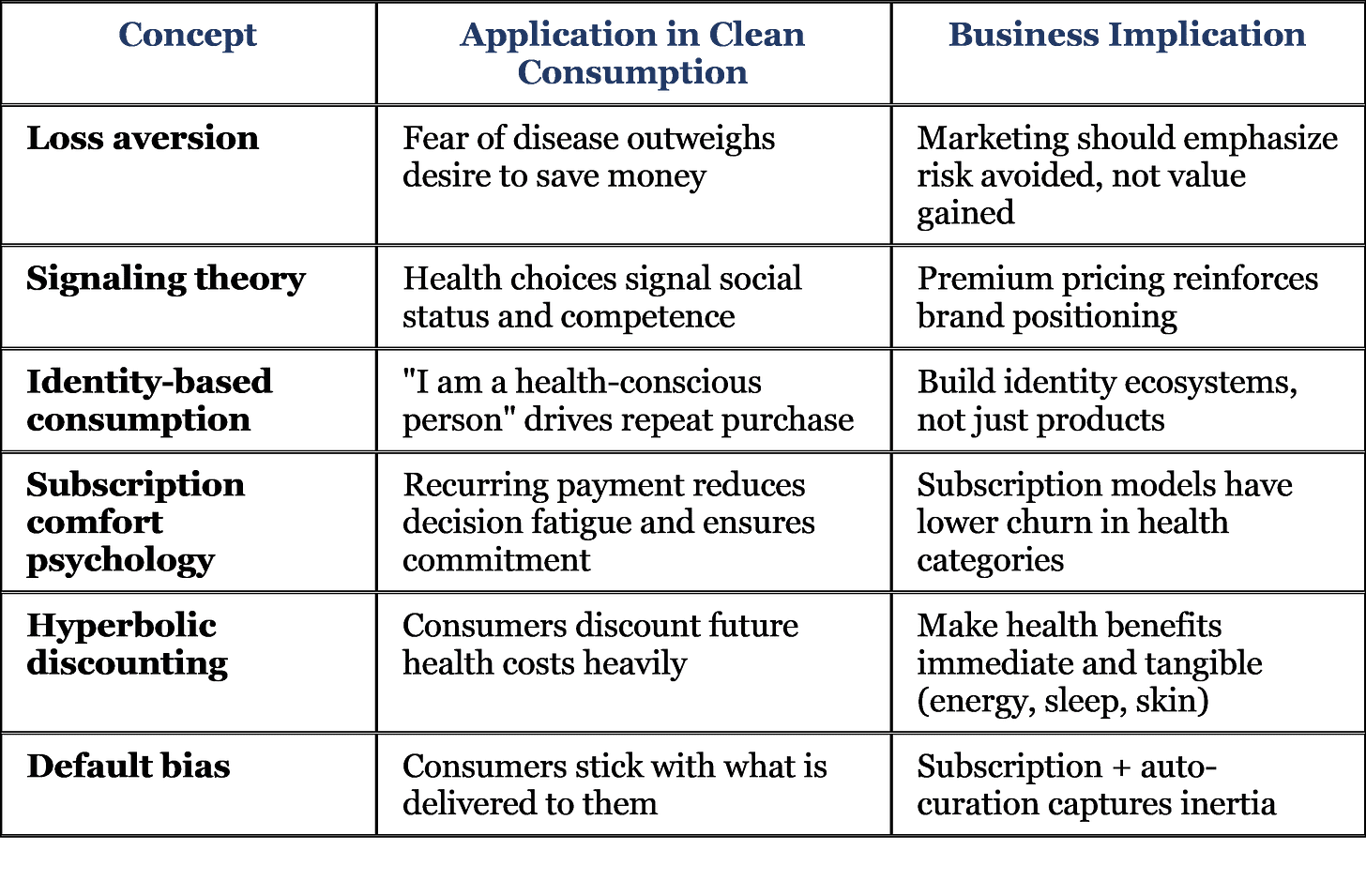
McKinsey’s 2024 Future of Wellness survey confirms that 82% of US consumers and 87% of Chinese consumers consider wellness a top or important priority. Gen Z and Millennial consumers are the most active buyers across all wellness categories. The behavioral economics of this market are structurally favorable: the psychological drivers are deep, non-cyclical, and intensifying with every new piece of health data that enters public consciousness.
3. Emerging Business Models in the Clean Consumption Ecosystem
A. Clean & Traceable Food Brands
Revenue model: Product sales with 40–65% gross margins via direct-to-consumer (DTC), supplemented by subscription revenue. Premium over conventional: 30–100%.
Farm-to-table models eliminate middlemen and capture margin that was previously distributed across 5–6 intermediaries. In India’s existing supply chain, a farmer earns ₹15 when the consumer pays ₹100. Platforms that compress this chain capture value at both ends — higher farmer income (increasing supply loyalty) and lower consumer price relative to quality (increasing demand stickiness).
Blockchain-enabled traceability converts transparency into a trust certificate. When 25% of Indian food samples fail FSSAI standards and 70.6% of milk samples test adulterated, the ability to show provenance from farm to fork is not a marketing gimmick — it is a risk mitigation tool that commands premium pricing. Country Delight’s DRDO-developed Milk-Testing Kit exemplifies this approach.
Chemical-free certification ecosystems represent an infrastructure play. India’s organic food market is projected to grow from $8.63 billion in 2024 to $21.99 billion by 2033 at a CAGR of 10.94%. Third-party certification, testing, and audit businesses will grow in lockstep, earning recurring revenue on a percentage-of-value basis.
Scalability: High for brands with digital-first distribution. Capital-intensive for those building cold-chain infrastructure. Defensibility improves with proprietary farmer networks and certification moats.
B. Functional & Preventive Nutrition
Revenue model: Premium product sales (50–70% gross margins) plus subscription recurring revenue. Personalized supplement subscriptions command 3–5x margins versus commodity vitamins.
Gut-health brands capitalize on the growing clinical evidence linking the microbiome to every major NCD. Ultra-processed foods are associated with decreased microbial diversity and increased pro-inflammatory organisms. Brands selling probiotics, prebiotics, and fermented nutrition (kombucha, kefir, traditional fermented foods) are monetizing this science.
Protein and low-glycemic innovation addresses India’s 101 million diabetics and 136 million pre-diabetics directly. Products engineered for low glycemic response — millet-based snacks, protein bars, low-GI flours — convert a medical need into a consumer product category.
Dairy alternatives represent the intersection of lactose intolerance (60–70% of Indians), A1 casein concerns, and plant-based trends. The global plant-based food market is projected to grow from approximately $14–51 billion in 2025 to $44–104 billion by 2034, depending on the scope of measurement, at CAGRs of 8–12%.
Personalized supplement subscriptions leverage blood marker data and AI to deliver individualized formulations monthly. This model combines high margins (60%+), recurring revenue, and data moats that deepen with each subscriber’s health history.
Scalability: Very high for digital-first brands. Manufacturing can be outsourced initially. Key defensibility: proprietary formulations, clinical validation data, and personalization algorithms.
C. Healthy Quick Service Restaurants (QSR 2.0)
Revenue model: Unit-level economics driven by average order value ($18–31), throughput per hour, and food cost ratios. Target restaurant-level EBITDA margins: 15–22%.
India’s fast food market reached $18.6 billion in 2024 and is projected to hit $35.5 billion by 2033. The counter-movement — health-positioned QSR — is emerging as a category distinct from both traditional fast food and fine dining.
Macro-counted meals appeal to the growing fitness-conscious segment that tracks protein, carbohydrates, and fats. These businesses monetize nutritional precision as a service layer on top of food.
Transparent kitchen models invert the opacity of existing food service. When Ahmedabad mandated TPC testers for restaurants, only 13 of 42 establishments complied. The restaurant that voluntarily displays oil quality, ingredient sourcing, and kitchen cameras converts regulatory failure into competitive advantage.
Oil-free cooking positioning addresses the deep-frying culture that dominates Indian food delivery. Restaurants using air-frying, steaming, or cold-press preparation methods can charge 20–40% premiums for a health narrative grounded in chemistry rather than marketing.
Cloud kitchen health verticals offer the capital-light version: lower rent, no front-of-house costs, digital-only ordering. Combined with macro tracking and subscription models (e.g., weekly meal plans), these can achieve breakeven within 6–9 months at moderate urban volumes.
Scalability: Moderate at unit level. Sweetgreen’s model — achieving profitability at approximately 36 orders per hour and $31 average order value — provides a benchmark. Automation (Sweetgreen’s Infinite Kitchen) offers a path to higher-margin scale.
D. Testing & Transparency Startups
Revenue model: Hardware margins (20–40%) plus recurring consumable/subscription revenue (60%+ margins). SaaS-like economics for platform models.
Home adulteration test kits address a market where 25% of food fails safety standards. Country Delight’s DRDO-developed milk testing kit is a first mover, but the category extends to oils (60–85% of mustard oil adulterated), spices (67% of turmeric adulterated), and produce (calcium carbide ripening).
Food scanning apps using AI can analyze ingredient lists with approximately 92% accuracy, identifying hidden sugars, emulsifiers, trans fat indicators, and artificial additives. The unit economics are digital: near-zero marginal cost per scan after initial development.
Blood marker tracking platforms capitalize on the fact that six biomarkers can identify metabolic dysfunction years before clinical disease. Platforms that integrate lab results, wearable data, and AI interpretation create longitudinal health records that become more valuable over time.
Continuous glucose monitoring for wellness is projected to grow from $2.3 billion in 2024 to $8.7 billion by 2033 at a CAGR of 15.7%. Abbott aims to grow its FreeStyle Libre franchise to $10 billion in sales by 2028, partly driven by Lingo, its consumer-grade wellness CGM. This is the paradigmatic example of a medical device becoming a consumer lifestyle product.
Scalability: Very high for software/platform models. Hardware models require supply chain investment but benefit from consumable lock-in. Defensibility: data moats, regulatory approvals, network effects.
E. AI-Driven Food Intelligence
Revenue model: Freemium app with premium subscription ($5–15/month), B2B licensing to food brands and retailers, data monetization (anonymized, aggregated).
Ingredient risk scanners convert the information asymmetry that sustains the disease economy into a consumer tool. India-specific platforms like HealthifyMe (40 million+ users) offer AI-powered meal tracking across one lakh+ Indian food items in 10+ languages, with clinical outcomes showing 65% of diabetic users experiencing significant HbA1c reductions.
Personalized diet copilots use blood markers, activity data, food diaries, and genetic information to generate individualized meal plans. A 2024 study found 31% reduction in high-sodium meal consumption when AI-generated nutritional flags were enabled.
Grocery optimization algorithms analyze a household’s purchase patterns, health profiles, and budget constraints to recommend optimal grocery baskets. This model creates value through waste reduction, health improvement, and cost optimization simultaneously.
Scalability: Extremely high — marginal cost approaches zero. Key defensibility: proprietary health data, AI model quality, and user engagement metrics. India’s diet app market generates ₹900–1,200 crore annually and is growing at double-digit rates.
F. Health-Focused Community & Membership Models
Revenue model: Membership fees ($50–500/month), product sales to community, events, and experiences. Lifetime value driven by community stickiness and identity attachment.
Longevity clubs aggregate biohacking protocols, health testing, supplement access, and community into a membership model. This borrows from the fitness club playbook but layers in health optimization.
Biohacking communities monetize the most dedicated segment of health consumers — those wearing CGMs, tracking blood markers, experimenting with protocols. The global wellness consumer market is $1.5 trillion, with personal health optimization as the fastest-growing segment.
Clean eating subscription boxes deliver curated, tested, chemical-free groceries weekly or monthly. The subscription model creates predictability (90%+ retention in health categories) and data about consumption patterns.
School lunch reform businesses address the institutional gap: only 18.75% of private school canteens in India feature menus with 80%+ healthy foods. The enterprise B2B model — selling nutritional meal programs to schools — offers institutional scale with recurring contracts.
Scalability: Moderate for physical community models, high for digital communities. Key defensibility: brand identity and community network effects.
4. Global Case Studies
Whole Foods Market (🇺🇸 United States)
Problem monetized: Consumer distrust of conventional grocery supply chains; demand for organic, natural, and transparently sourced products.
Premium strategy: Positioned as “America’s Healthiest Grocery Store.” Charged 20–80% premiums over conventional grocery on organic produce, clean-label products, and curated specialty items. Under Amazon, strategic price reductions on key items while maintaining margin on high-value categories.
Trust lever: Rigorous quality standards, in-store transparency (ingredient lists, sourcing stories), and a brand identity synonymous with “if it’s at Whole Foods, it’s safe.” The brand itself became the trust certificate.
Scalability model: Expanded to 535 locations with 40%+ sales growth since 2017 acquisition by Amazon. Amazon layered digital ordering, Prime integration, and logistics infrastructure onto Whole Foods’ physical trust infrastructure. Net sales from Amazon’s physical stores, primarily Whole Foods, surpassed $20 billion in 2024. Amazon has since generated over $100 billion in gross grocery and household essentials sales in 2024.
Lesson for emerging markets: Trust-based grocery retail can scale to hundreds of billions when paired with logistics and digital infrastructure. India’s equivalent requires solving cold-chain and last-mile simultaneously.
Sweetgreen (🇺🇸)
Problem monetized: Time-poor urban professionals wanting healthy, fast-casual meals without the quality compromise of traditional QSR.
Premium strategy: Average order value of $24, targeting profitability at $31. Seasonal menus, digital-first ordering (~50% of sales from digital channels), and sustainability positioning justify the premium.
Trust lever: Ingredient transparency, locally sourced produce, seasonal rotation that signals freshness. The Infinite Kitchen automation system (acquired via Spyce) delivers consistency while improving margins.
Scalability model: Over 250 locations by 2025, targeting 1,000 by 2030. Revenue of $685 million with 17% CAGR over six years. Low-to-mid-teens annual unit growth. Automating food preparation via Infinite Kitchen units to improve throughput and reduce labor costs.
Lesson for emerging markets: Health-positioned QSR scales when it solves for throughput, not just quality. Automation is the margin lever that makes healthy food operationally competitive with traditional fast food.
Oatly (🇪🇺 / 🇸🇪 )
Problem monetized: Dairy intolerance, environmental concerns, and the cultural shift away from animal products.
Premium strategy: Positioned as a lifestyle brand, not merely an alternative milk. Oat-based products command 40–100% premiums over conventional dairy. Revenue reached $862.5 million in 2025, achieving its first full year of profitability as a public company. Volume sold reached 593 million liters in 2025, up 18% versus 2022.
Trust lever: Sustainability narrative, transparent manufacturing communication, and barista-channel seeding — by making Oatly the default oat milk in specialty coffee shops, it created social proof at scale.
Scalability model: Operations in 50+ countries. Gross margin expanded to 32%. Growth driven by retail expansion in Europe and International (13.9% volume increase), with foodservice as an anchor channel.
Lesson for emerging markets: In markets with high lactose intolerance (60–70% of India), dairy alternatives represent a massive latent demand. Barista-channel seeding creates cultural adoption before retail scaling.
Country Delight (🇮🇳)
Problem monetized: Milk adulteration and consumer distrust of dairy supply chains. In India, 70.6% of milk samples in one study were found adulterated, and 41% failed at least one quality parameter in FSSAI’s own survey.
Premium strategy: Direct-to-home subscription model delivering farm-fresh milk and dairy within 24–36 hours of sourcing. Revenue reached ₹1,380 crore in FY24. Post-money valuation at $820 million, with Temasek as the largest external shareholder at 13.63%.
Trust lever: Full-stack supply chain with real-time traceability, DRDO-developed home milk-testing kits, and elimination of middlemen. The brand converted “milk purity” from an abstract claim into a testable, verifiable attribute.
Scalability model: Serves 1.5 million customers across 25+ cities. Expanding into quick commerce (10–15 minute delivery pilot in Gurugram), and diversifying into pulses, grains, spices, oils, pickles. Raised $220+ million through debt and equity. Preparing for IPO.
Lesson for emerging markets: In markets with deep trust deficits, owning the supply chain end-to-end is the defensible moat. Test-kit-based proof of purity is a replicable trust lever across food categories.
Epigamia (🇮🇳)
Problem monetized: Absence of premium, health-positioned dairy snacking options in India’s ₹500+ crore organized yogurt and dairy market.
Premium strategy: Greek yogurt priced 2–3x above Amul and Mother Dairy equivalents. Extended into smoothies, plant-based (coconut milk yogurt), and mishti doi. Total funding: ₹597.64 crore. Backed by Verlinvest, Danone Manifesto Ventures, and DSG Consumer Partners.
Trust lever: Product innovation and cold-chain investment over discount wars. Rather than competing on price, invested in regional manufacturing and R&D for Indian taste preferences. Available across modern trade, e-commerce, and quick commerce platforms.
Scalability model: Now a ₹500+ crore brand expanding beyond metros into Tier 2 and Tier 3 cities. Raised $18.3 million in its latest funding round. Disciplined growth without aggressive diversification.
Lesson for emerging markets: Premium dairy positioning works when backed by genuine product differentiation. Cold-chain logistics investment is non-negotiable for dairy premiumization in India.
Farmizen (🇮🇳)
Problem monetized: Consumer disconnection from food origins and the impossibility of verifying organic claims in urban India.
Premium strategy: Community-based farming model where consumers rent a 600 sq. ft. farm plot for approximately ₹2,500/month and choose what to grow. Tribe-based group ordering model for organic produce delivery.
Trust lever: Complete transparency — consumers can visit their farm, see their crops growing, and verify organic practices firsthand. Farmizen performs regular inspections and provides agronomy support to partner farmers.
Scalability model: Currently operating in Bengaluru and Hyderabad. App-based ordering and Tribe Leaders as community aggregation points reduce last-mile delivery costs. Building an alternate supply chain optimized for soil health, farmer income, and consumer health simultaneously.
Lesson for emerging markets: Radical transparency — letting consumers see their food being grown — is the ultimate trust lever. Community aggregation reduces unit economics pressure. The model is replicable across Indian metros with peri-urban agricultural belts.
Additional International References
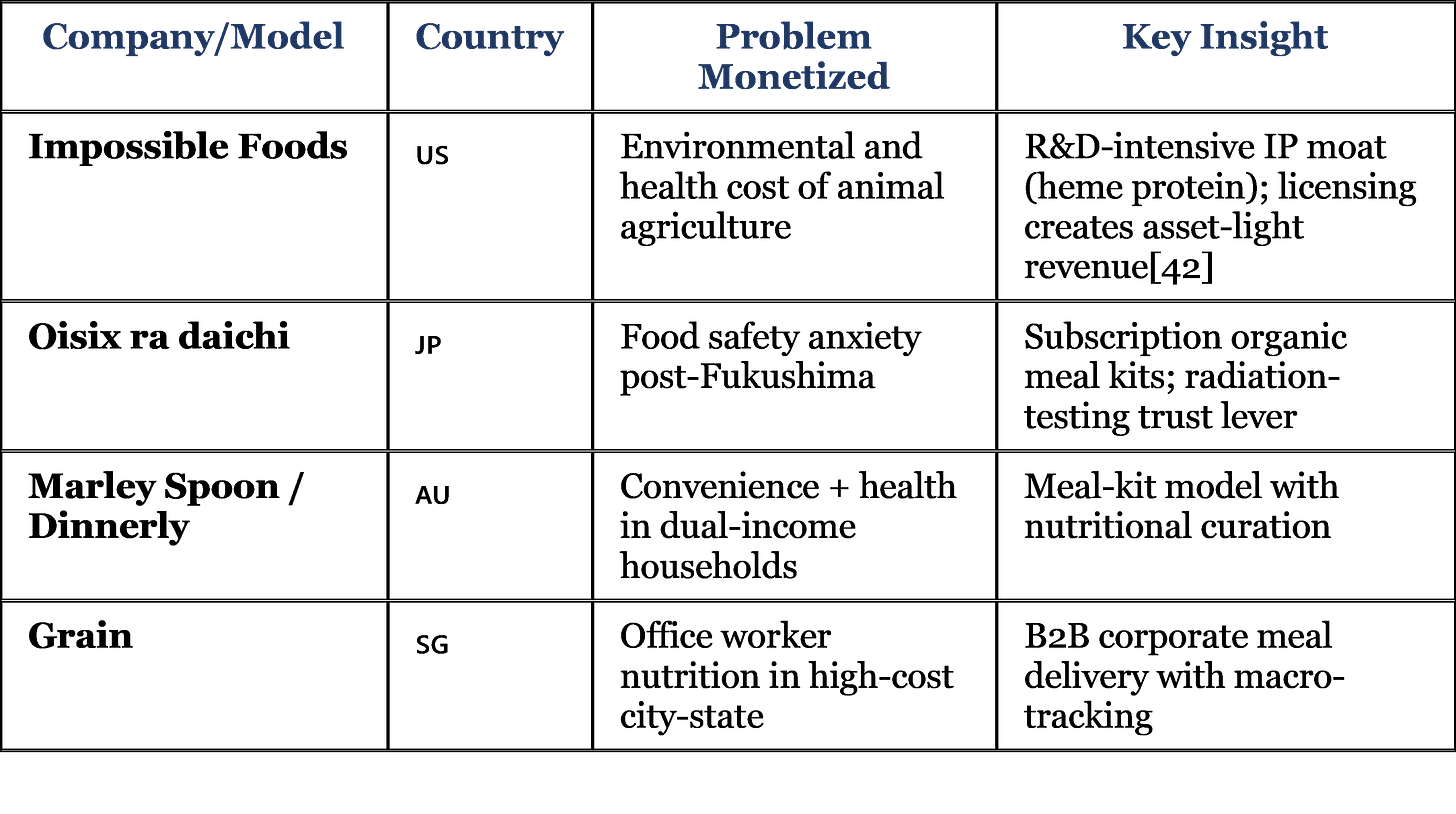
5. Adjacent Industries Emerging Because of the Health Shift
The clean consumption revolution does not exist in isolation. It is catalyzing growth across an interconnected ecosystem of adjacent industries, each representing a distinct investment and entrepreneurial opportunity.
Organic Farming Ecosystems
India’s organic food market is projected to reach $21.99 billion by 2033. This growth requires upstream investment in organic seed supply, soil testing, certification infrastructure, and farmer training platforms. The government’s National Program for Organic Production (NPOP) and subsidies for organic farming are accelerating supply-side development. Two Brothers Organic Farms raised ₹110 crore in Series B funding in 2025, signaling investor confidence.
Cold-Chain Logistics Innovation
Over 60% of India’s fresh foods market is unorganized with limited cold storage capabilities. Country Delight’s full-stack supply chain model demonstrates that cold-chain investment is the enabling infrastructure for the entire clean consumption economy. Cold-chain logistics is a ₹50,000+ crore opportunity in India, with demand driven simultaneously by clean food brands, pharma distribution, and e-grocery.
Testing Laboratories
When 25% of food samples fail FSSAI standards, the testing infrastructure becomes a growth industry. Third-party labs offering rapid adulteration testing, nutritional verification, and safety certification will grow in lockstep with consumer demand for transparency. The laboratory testing market benefits from recurring revenue (brands must test every batch) and regulatory tailwinds.
Wellness Real Estate
The global wellness real estate market surged from $225 billion in 2019 to $548 billion in 2024 — growing at 19.5% annually, nearly 4x the rate of overall global construction. The GWI forecasts this market will approach $1.1 trillion by 2029. Features include wellness gyms, air/water purification systems, biophilic design, circadian lighting, and integrated fitness facilities. The U.S. leads at $181 billion, with India and Asia-Pacific among the fastest-growing regions.
Health Insurance Redesign
Indians with diabetes or hypertension face 25–50% higher insurance premiums and waiting periods of two to four years. Insurers are beginning to redesign products that reward preventive behavior: discounts for gym memberships, wearable data sharing, and verified healthy consumption patterns. This creates a health fintech intersection where clean consumption data becomes an insurance input.
Fitness Tech
Around half of consumers surveyed by McKinsey have purchased a fitness wearable, with 75% open to using one in the future. The wearables market is evolving from step-counting to metabolic monitoring (CGMs, biometric rings, sleep trackers). The CGM devices market is projected to reach $54.6 billion by 2035.
Corporate Wellness Platforms
As healthcare costs rise, employers are investing in employee wellness to reduce insurance premiums and productivity loss. Corporate meal delivery (macro-counted office lunches), on-site health screening, and wellness app subscriptions represent a growing B2B channel for clean consumption brands.
School Nutrition Businesses
With childhood obesity prevalence at 8.4% nationally and up to 21.9% in urban areas, school nutrition is an institutional market. Only 18.75% of private school canteens meet healthy food standards. The UNICEF Child Nutrition Report 2025 confirms obesity has overtaken undernutrition as the most common form of malnutrition among school-aged children globally. B2B school nutrition contracts offer recurring revenue with institutional stickiness.
Health Fintech (Health-Linked Rewards)
The convergence of health data and financial services creates models where verified healthy behavior (tracked via wearables, purchase data, or biomarker results) translates into financial rewards: lower insurance premiums, cashback on healthy groceries, or wellness-linked savings products. This is the financial infrastructure layer of the prevention economy.
6. Unique Business Opportunities Yet Underexplored (Especially in India)
1. Adulteration Audit Subscription for Households
Concept: Monthly subscription (₹500–1,500/month) providing home testing kits for milk, oil, spices, and produce, combined with AI-powered reporting and sourcing recommendations.
Unit economics: Kit COGS ₹150–300; subscription revenue ₹500–1,500; gross margin 55–75%. At 50,000 subscribers, monthly recurring revenue reaches ₹2.5–7.5 crore.
Defensibility: Proprietary testing IP (similar to Country Delight’s DRDO kit), data moat from aggregate adulteration mapping, and supplier recommendation network effects.
2. Restaurant Transparency Certification Platform
Concept: Independent, Zomato/Swiggy-integrated certification that rates restaurants on oil reuse frequency, ingredient sourcing, kitchen hygiene, and nutritional disclosure. Restaurants pay for certification; consumers filter by rating.
Unit economics: Annual certification fee ₹25,000–1,00,000 per restaurant; audit costs ₹5,000–15,000. At 10,000 certified restaurants, revenue reaches ₹25–100 crore annually.
Defensibility: Network effects (more consumers trust the certification → more restaurants seek it), regulatory tailwind (FSSAI’s voluntary Hygiene Rating covers fewer than 1,860 businesses nationwide).
3. AI-Powered Grocery Basket Optimizer
Concept: App that photographs a user’s kitchen, analyzes existing inventory, cross-references family health profiles, and generates a weekly grocery list optimized for nutrition, budget, and waste reduction.
Unit economics: Freemium model with premium at ₹199–499/month. Affiliate revenue from partner brands adds ₹50–100/user/month. At 500,000 premium subscribers, ARR reaches ₹120–300 crore.
Defensibility: Proprietary AI model trained on Indian dietary patterns, health data integration, and user retention driven by personalization.
4. Child Nutrition Behavioral Coaching Startup
Concept: Subscription service combining AI-powered meal planning for children, behavioral coaching for parents (addressing the food-as-reward pattern), and school canteen consulting.
Unit economics: ₹999–2,499/month family subscription; school contracts at ₹3–5 lakh annually. At 25,000 family subscribers + 200 school contracts, ARR reaches ₹30–70 crore.
Defensibility: Clinical validation of child health outcomes, integration with pediatricians, and brand trust built through measurable results (child BMI, dietary diversity scores).
5. Premium Oil Testing & Sourcing Brand
Concept: Vertically integrated brand selling tested, certified-pure cooking oils (mustard, groundnut, coconut, sesame) with batch-level lab reports accessible via QR code. Addresses the finding that 60–85% of mustard oil samples are adulterated.
Unit economics: 40–60% gross margin on premium-priced oils. Monthly subscription ₹800–2,000/household. At 100,000 subscribers, MRR reaches ₹8–20 crore.
Defensibility: Batch-level traceability, direct farmer sourcing contracts, and brand trust built through verifiable purity claims.
6. Clean Dairy Verification Chain
Concept: A2 milk verification + antibiotic residue testing + blockchain traceability from indigenous cow breeds (Gir, Sahiwal) to consumer doorstep. India produces 230 million tonnes of milk annually, but most crossbred cattle produce A1 milk linked to inflammatory biomarkers.
Unit economics: Premium of 50–100% over commodity milk. Subscription model at ₹2,500–5,000/month for a family of four. Farmer premium of 20–30% ensures supply loyalty.
Defensibility: Indigenous breed sourcing networks, antibiotic testing infrastructure, and clinical evidence marketing (A1 vs. A2 studies).
7. Health Impact Scoring for Housing Societies
Concept: Assessment and certification service that scores residential complexes on air quality, water purity, proximity to green spaces, availability of fitness infrastructure, and food delivery ecosystem healthiness.
Unit economics: Assessment fee ₹2–5 lakh per society; annual recertification ₹1–2 lakh. Premium societies (5,000+ in India’s top 10 cities) represent a ₹50–250 crore addressable market.
Defensibility: First-mover certification brand, integration with wellness real estate developers, and data-driven scoring methodology.
8. Prevention-Focused Community Clinics
Concept: Neighborhood clinics focused exclusively on metabolic health prevention: biannual biomarker panels (fasting insulin, hs-CRP, ApoB, liver enzymes, TG:HDL ratio), AI-interpreted results, and personalized lifestyle protocols. Zero curative services.[1]
Unit economics: ₹3,000–8,000 per biannual assessment; annual membership ₹12,000–25,000. At 10,000 members per clinic, revenue per clinic reaches ₹12–25 crore annually.
Defensibility: Proprietary health scoring algorithms, longitudinal data on member outcomes, and community network effects (families refer families).
7. The Premium Paradox: Why Higher Price Can Be Advantage
Premium Pricing Builds Trust
In the health category, low pricing is a liability. When a consumer is choosing between ₹60/liter milk and ₹90/liter milk, and they know that 70.6% of milk samples are adulterated, the ₹60 price point triggers suspicion, not gratitude. Premium pricing in health serves as a trust signal — it communicates that the brand has invested in quality sourcing, testing, and supply chain integrity. Research confirms that a premium purchase is generally regarded as one of the strongest results of brand loyalty.
The Margin Requirement for Quality Sourcing
Organic production is characterized by higher labor costs and lower yields than conventional production. A brand selling organic mustard oil at commodity prices either loses money or cuts corners on sourcing — there is no third option. The premium must be high enough to cover the genuine cost of chemical-free farming, fair farmer compensation, cold-chain logistics, and third-party testing. Consumers who understand this equation — and the urban upper-middle class increasingly does — view premium pricing as a quality guarantee, not an overcharge.
The Danger of Competing on Price in Health
Brands that attempt to win health-conscious consumers through discounting face three structural problems:
-
Margin erosion prevents quality investment. The 40–65% gross margin needed for genuine clean sourcing, testing, and cold-chain cannot be maintained at competitive pricing.
-
Consumer trust erosion. Price-conscious consumers are the wrong customer for health-premium products. Acquiring them through discounts creates a customer base that churns when the discount ends.
-
Race to the bottom. Price competition in health categories attracts competitors who cut corners on quality, eventually degrading category trust for all players.
Affluent Early Adopters Create Market Validation
The playbook is consistent across every successful clean consumption brand: price high, start narrow, expand later. Whole Foods began as a premium retailer for affluent consumers before Amazon scaled it. Oatly seeded through specialty coffee shops (the most premium channel) before entering mainstream retail. Country Delight launched in Delhi NCR’s affluent neighborhoods before expanding to 25+ cities. The affluent early adopter is not just a customer — they are a marketing channel, a social proof generator, and a validator of willingness-to-pay that enables subsequent scaling.
8. Investment Lens
Venture-Scale Segments (Potential for $1B+ Outcomes)
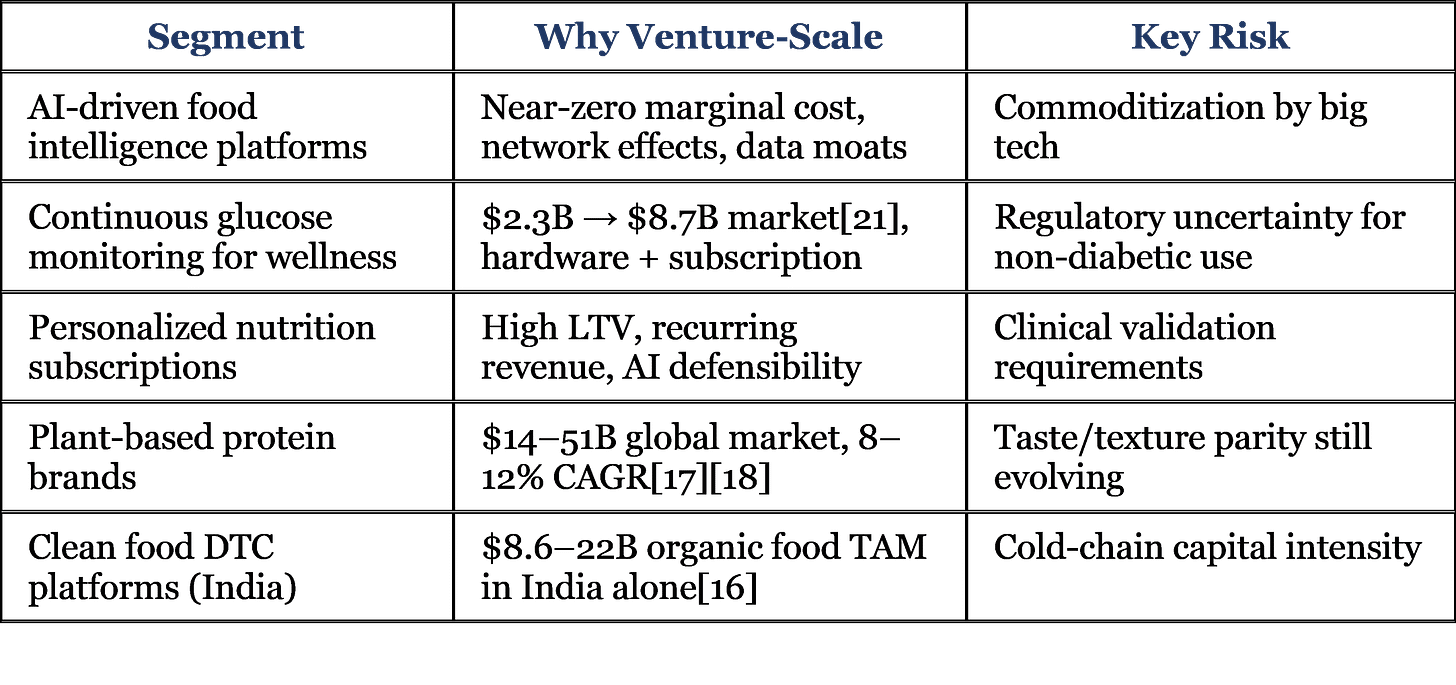
SME-Scalable Segments (₹50–500 Crore Revenue Potential)
· Premium cooking oil brands with batch-level testing
· Regional clean dairy chains (A2 milk, antibiotic-free)
· Health-focused cloud kitchen networks (10–50 kitchens per city)
· School nutrition B2B services
· Adulteration testing subscription services
These segments do not require venture capital. They can be built profitably with internal accruals or debt financing, reaching ₹50–500 crore in revenue with 15–25% EBITDA margins. The key advantage: they serve local trust relationships that national brands cannot easily replicate.
Hyperlocal Opportunities
· Community farming models (Farmizen-style) — viable in any metro with peri-urban agricultural access
· Neighborhood clean kitchens serving 500–2,000 subscribers
· Housing society health scoring and audit services
· Local organic farmer aggregation cooperatives
Hyperlocal models generate cash flow quickly, require minimal capital, and build deep community moats. They are ideal for family business operators and first-time entrepreneurs.
Asset-Light Digital Plays
· Food scanning and ingredient analysis apps
· Health marketplace aggregators (connecting consumers to tested/certified products)
· Restaurant transparency rating platforms
· AI diet copilot applications
· Health data analytics for insurance companies
These require primarily engineering talent and data. They can reach profitability with 100,000–500,000 users and scale non-linearly beyond that. The Indian diet and health app market already generates ₹900–1,200 crore annually.
Regulatory Tailwinds
Several segments stand to benefit from anticipated regulatory tightening:
· Oil reuse standards: FSSAI’s TPC mandates, if enforced, create demand for TPC testing devices and transparent kitchen models.
· Food labeling reform: Mandatory front-of-pack nutrition labeling (following global trends) benefits clean-label brands.
· Child food advertising restrictions: India currently has no specific legal framework regulating food advertising to children. When regulation arrives (as it has in Chile, UK, Mexico), it redirects child-food spending toward compliant health brands.
· Organic certification standardization: Improved certification frameworks increase consumer trust in organic claims, expanding the addressable market.
9. Ten-Year Outlook (2026–2036)
Clean Food Becomes Mainstream (2026–2030)
The current premium positioning of clean food brands will shift to mainstream within five years. India’s organic food market growing at 10.9–19.3% CAGR means it will 3–5x in size by 2033. As production scales, costs decline, and distribution expands to Tier 2/3 cities, price premiums will compress from 50–100% to 20–40%, making clean food accessible to the upper mass market. The tipping point occurs when quick commerce platforms (Blinkit, Zepto, Swiggy Instamart) begin prioritizing clean-label products in their assortment algorithms — which is likely by 2028.
Pharma + Nutrition Convergence (2027–2032)
The boundary between pharmaceutical and nutritional interventions is dissolving. The chronic therapy segment already represents 53% of India’s domestic pharma market, and the rise of GLP-1 agonists (semaglutide) for weight management — at ₹10,000/month per patient — is just the beginning. Within seven years, expect:
· Pharma companies launching branded functional food lines
· Nutraceutical companies seeking drug-approval pathways for validated formulations
· Insurance companies reimbursing nutritional interventions that demonstrate clinical outcomes
· Regulatory convergence between FSSAI (food) and CDSCO (pharma) for functional health products
AI-Based Personal Health Scoring (2027–2030)
The combination of wearable data (CGMs, biometric rings, smartwatches), blood marker tracking, genomic data, and dietary analysis will enable real-time personal health scores. These scores will function like credit scores for health — used by insurers for premium calculation, by employers for wellness programs, and by consumers for self-optimization. The infrastructure for this exists today; what’s needed is integration, standardization, and consumer adoption, all of which are accelerating.
Subscription-Based Health Ecosystems (2028–2033)
The future of clean consumption is not individual product purchases but integrated health subscriptions. A family will pay ₹5,000–15,000/month for an ecosystem that includes:
· Weekly delivery of tested, clean groceries
· Biannual biomarker panels with AI interpretation
· CGM or metabolic wearable access
· AI diet copilot and meal planning
· Access to a longevity community or health club
· Insurance premium discounts linked to verified health data
This bundled model dramatically increases customer lifetime value and creates switching costs that make churn extremely low. The companies that build these integrated ecosystems — whether starting from food (Country Delight), health tech (HealthifyMe), or insurance — will capture the largest share of the prevention economy.
School & Corporate Institutional Demand (2026–2032)
Institutional demand will provide the volume base for the clean consumption economy. Schools facing regulatory pressure (and parental demand) will contract with nutrition providers for canteen management. Corporations, facing rising health insurance costs and employee productivity concerns, will invest in workplace nutrition, wellness platforms, and preventive health benefits. This B2B layer — less visible than consumer brands but potentially larger in revenue — will underpin the unit economics of the entire ecosystem.
The Strategic Imperative
The transition from disease economy to prevention economy is not a prediction — it is an observation of a process already underway. The global preventive healthcare market growing at 12.45% CAGR, the wellness economy reaching $6.8 trillion, Indian organic food growing at 10.9–19.3%, and CGM wellness growing at 15.7% — these are not speculative projections. They are measured trajectories backed by consumer spending data, clinical evidence, and venture capital allocation.
The question for founders, investors, family business owners, SME operators, policymakers, and homemakers is not whether this transition will happen. It is whether they will participate in the wealth creation side of it — or continue subsidizing the disease economy that costs India $4.58 trillion and pushes 55–100 million citizens into poverty annually.
The economics are clear. The consumer demand is documented. The technology exists. The models are proven. What remains is execution — and the market rewards those who move first.
Disclaimer
Views expressed are solely the author’s own and for informational purposes only. Not financial, medical, or investment advice. © Kirtiraj Gohil | Blue Mango Consulting Group.